
BIMTECH Business Perspectives


Rajeev Kumar1 
1 School of Management, Doon University, Dehradun, Uttarakhand, India

Creative Commons Non Commercial CC BY-NC: This article is distributed under the terms of the Creative Commons Attribution-NonCommercial 4.0 License (http://www.creativecommons.org/licenses/by-nc/4.0/) which permits non-Commercial use, reproduction and distribution of the work without further permission provided the original work is attributed.
The article provides a theoretical review of the impact of digital technologies on traditional business practices. The article suggests some of the important strategies for businesses to adapt, innovate, and thrive in a digitally disruptive landscape. The article emphasizes the importance of data-driven decision-making, customer-centric approaches, and agile management practices to excel in the competitive market. The present study provides pertinent and actionable insights to organizations, policymakers and researchers for maximizing resilience, agility and sustainable growth amid digital disruption.
Digital disruption, marketing transformation, management strategy, business innovation, digital transformation, technology adaptation
Introduction
The rapid acceleration of digital technologies has transformed the global business landscape, forcing organizations to adapt or risk obsolescence. Digital disruption, characterized by the emergence of new technologies that challenge traditional business models, has become a defining factor in modern marketing and management practices. Companies across industries must navigate this disruption effectively to maintain competitive advantages, drive innovation, and ensure sustainable growth. The integration of digital tools, data analytics, artificial intelligence (AI), and automation has revolutionized customer engagement, operational efficiency, and decision-making processes. As businesses face these profound changes, strategic transformation in marketing and management has become imperative (Bughin et al., 2018). Digital disruption refers to the transformation brought about by digital technologies that challenge the status quo, alter consumer behavior, and redefine industry dynamics. Unlike traditional market disruptions, which typically stem from new competitors or economic shifts, digital disruption is driven by technological advancements such as AI, machine learning, blockchain, big data, and cloud computing (Berman, 2012). Organizations that fail to foresee and embrace these changes face the risk of becoming obsolete, as seen in cases such as Kodak’s inability to transition to digital photography and Blockbuster’s failure to compete with streaming services like Netflix. Marketing, an important function for customer acquisition and retention, has been deeply impacted by digital advancements. Traditional marketing strategies that relied on television, print, and radio have been supplemented, and in some cases replaced, by digital marketing techniques such as search engine optimization (SEO), social media marketing, content marketing, and influencer collaborations (Chaffey & Ellis-Chadwick, 2019). These digital strategies allow businesses to reach target audiences more effectively, track consumer behavior through analytics, and personalize marketing campaigns for better engagement. The shift toward data-driven marketing necessitates an agile approach that prioritizes customer insights and real-time decision-making. AI-powered chatbots, recommendation engines, and programmatic advertising have enabled companies to deliver hyper-personalized experiences to consumers (Davenport et al., 2020). Businesses that adopt these technologies can create more dynamic, responsive, and effective marketing strategies, leading to improved customer satisfaction and brand loyalty. Beyond marketing, management practices also must evolve to stay abreast of digital disruption. Traditional hierarchical organizational structures are giving way to more agile, flexible, and collaborative models. Companies that adopt digital transformation strategies, such as lean management, remote workforce integration, and data-driven decision-making, gain a significant competitive edge (Westerman et al., 2014). Leaders must build a culture of innovation, where employees are encouraged to experiment, adapt, and leverage technology to enhance productivity. Furthermore, digital tools enable better supply chain management, predictive analytics, and automated workflow processes, which improve operational efficiency and cost-effectiveness (Bharadwaj et al., 2013). Companies leveraging cloud computing and enterprise resource planning (ERP) systems can streamline operations and enhance cross-functional collaboration. As digital transformation continues to evolve, organizations must prioritize continuous learning, upskilling, and reskilling to ensure that employees remain equipped with the necessary digital competencies.
Effective leadership is critical in guiding organizations through digital disruption. Leaders must possess a clear vision for digital transformation and be willing to invest in emerging technologies, workforce development, and innovative business models. Digital-savvy executives must champion change management initiatives and foster a culture of adaptability and resilience (Kane et al., 2015). Companies that successfully integrate digital strategies into their core operations position themselves for long-term success in an increasingly volatile market. Managing digital disruption requires a strategic and proactive approach to marketing and management transformation. Businesses that embrace digital innovations, leverage data-driven decision-making, and foster an adaptive organizational culture will thrive in the digital era. Marketing must evolve to be more personalized and analytics-driven, while management practices must prioritize agility, efficiency, and technological integration. Leadership plays a crucial role in ensuring that organizations remain competitive and responsive to emerging trends. As digital disruption continues to reshape industries, companies must remain vigilant, innovative, and committed to continuous transformation to secure their future success. The pace of digital disruption is reshaping marketing practices and managerial decision-making, creating both opportunities and strategic challenges for organizations. This study is motivated by the need to understand how firms can effectively realign marketing and management strategies to sustain competitiveness, agility, and value creation in an increasingly digital business environment.
Literature Review
The rapid increase in digital technologies has fundamentally reshaped industries, challenging traditional marketing and management practices as the opportunities and risks it poses shift over time (Evans & Forth, 2015). In the present scenario organizations face unprecedented disruption driven by innovations such as AI, big data analytics, and digital platforms. These changes demand a shift from conventional approaches to more customer-centric strategies to remain competitive. Therefore, organizations are forced to adapt, innovate, and reinvent to stay relevant and competitive (Wang, 2024). Proper understanding is therefore critical for businesses to encash on digital opportunities while minimizing risks. This study focuses on digital disruption, marketing evolution, and management adaptation, and provides a comprehensive framework to guide organizations through this transition. The increase in digital technologies has transformed the operations in the industries, thus challenging traditional marketing and management practices owing to the opportunities and risks it creates over time (Evans & Forth, 2015). The innovations in the areas of AI, business analytics, and digital platforms have completely disrupted the business landscape. These disruptions demand more customer-centric strategies to remain competitive. Digital disruptions should not be viewed as a threat, but as a catalyst for transformation, which requires changing the marketing strategies that are future-focused, inclusive, and purpose-driven (Mogaji, 2025). To overcome digital disruptions smoothly, marketing simulations can be an efficient way to harness digital disruption. Marketing simulations define digital disruption as the change that takes place when new digital technologies change customer experiences, processes, and business models, thereby changing how value is co-created (Bolton et al., 2019). By focusing on techniques and tools such as online presence, customized marketing, social media engagement, content marketing, SEO, influencer collaborations, and performance monitoring, digital disruptions can be smoothly navigated, and marketing effectiveness can be enhanced to drive business growth in the digital landscape (Masliardi et al., 2023). The impact of digital transformation and disruptive technologies has impacted all industries globally. These disruptive technologies are related to AI, Robotics, Internet of Things (IoT), and Big Data. The main objective behind these technologies is to pace up the efficiency of the organizations. The use of AI can enhance the efficiency of the projects, making them less risky. Therefore, the use of AI ensures that the projects are less prone to risks and have a higher chance of success (El Khatib, 2024). Digital disruption often holds a negative connotation for businesses that view it as an attack on their existing business model, as it is thought of as a turmoil caused by digital innovation, which disturbs existing boundaries and reduces efficacy that had previously served to deliver customer value. However, digital disruption is negative only when businesses try to ignore the impending transformation within their industry. Rather than viewing it as negative, the visionary leaders embrace it to make their businesses competitive, which in turn leads to their continued success (Lee, 2024). Thus, the dynamic landscape of digital disruption and its impact on traditional marketing strategies is characterized by the introduction of innovative digital technologies and business models that have reshaped the marketing landscape for existing products and services. The role of social media in relationship marketing underlines its ability to foster a wide array of consumer-business interactions, ranging from short exchanges to in-depth exploration. Social media plays an indispensable role in contemporary relationship marketing strategies, meeting consumer needs, and building connections. Thus, a holistic understanding of the full impact of social media in this ever-evolving marketing landscape is important, and it can be taken up in future studies (Kabha et al., 2023). The literature review highlights the growing impact of digital disruption on marketing and managerial practices; however, limited research has specifically examined how organizations strategically respond to such disruptions to transform their marketing and management functions. This study addresses this gap by exploring integrated strategies that enable firms to adapt to digital transformation in dynamic market environments. By synthesizing insights from digital transformation and strategic management literature, the study advances theory by proposing a more comprehensive understanding of how digital capabilities influence organizational transformation and competitive advantage.
Objectives or Research Questions
Objectives:
Research questions:
Significance of the Study
The study addresses the urgent need for organizations to adapt to the rapidly evolving digital landscape. By providing insights, the study helps businesses to remain competitive and innovative amidst disruption. The study also contributes to the understanding of how digital tools and customer-centric approaches can drive sustainable growth, improve decision-making, and enhance organizational agility. Moreover, the study is useful in bridging the gap between traditional practices and modern demands, ensuring that businesses can effectively harness the opportunities presented by technological advancements and minimizing challenges.
Methodology
The study uses a qualitative approach to ensure a holistic understanding of the topic. Interviews provided valuable insights into best practices and challenges. Interviews with technology experts, retail managers, and marketers provided diverse perspectives and emerging trends. The participants were purposively selected based on their substantial professional experience, direct involvement with digital transformation initiatives, and domain-specific expertise relevant to the research objectives. Each interview lasted approximately 30–45 minutes and was conducted through a virtual platform (e.g., Zoom/Google Meet) or in-person, depending on participant availability, and participants provided informed consent prior to participation. The study used unstructured, in-depth interviews guided by broad, open-ended questions aligned with the research objectives. By interviewing four key people from different domains, the study highlights the current status of technology and how it is being employed by different companies. Data were analyzed using manual thematic analysis. No qualitative analysis software was used; all coding was performed manually to retain closeness to the data. The study adopts an exploratory qualitative approach where in-depth interviews are used to generate rich insights rather than statistical generalization. The selection of four key informants was based on their extensive experience and strategic roles in their respective industries, enabling a detailed understanding of digital disruption strategies. Nevertheless, future research may expand the sample size across multiple firms and industries to enhance generalizability. Additionally, the review helped to validate findings and provide a framework for strategic recommendations.
Results
Participant 1: Technology Industry
Description: This short, unstructured interview was conducted with a technology firm executive who has experienced digital transformation. The discussion focused on marketing adaptation strategies in response to digital disruption.
Transcript Excerpt: Interviewer: Can you describe how your organization has adapted its marketing strategies in response to digital disruption? Participant: Absolutely. Over the past five years, we have transitioned from traditional advertising to a digital-first approach. We rely heavily on data analytics to segment our audience and personalize content. AI-powered chatbots and automated customer engagement tools have enhanced our ability to interact with consumers in real-time. One of the biggest challenges has been ensuring our marketing teams are digitally fluent. We invested heavily in training and upskilling to bridge the knowledge gap.
Participant 2: Retail Industry
Description: This interview was conducted with a retail company executive to explore how management strategies have evolved due to digital disruption.
Transcript Excerpt: Interviewer: How has digital disruption changed your management approach? Participant: We had to rethink our entire operational strategy. Digital transformation meant integrating e-commerce, omnichannel supply chain solutions, and automation in warehouse management. Interviewer: What key strategies have been most effective. Participant: Agile management has been a game changer. We now work in shorter cycles, continuously iterating based on data insights. Employee resistance to change was an issue initially, but we addressed it through continuous communication and incentives for adopting digital tools.
Participant 3: Financial Services Industry
Description: A participant from a financial services company discussed leadership and strategic decision-making in navigating digital disruption.
Transcript Excerpt: Interviewer: As a leader, how do you approach digital transformation within your organization? Participant: Digital transformation is not just about technology it’s about people and culture. We build a culture of innovation and encourage employees to embrace new digital tools. Our leadership team prioritizes investment in fintech solutions to remain competitive. Interviewer: Have you encountered any major roadblocks. Participant: Cybersecurity has been a primary concern. As we integrate more digital services, we must also strengthen our security frameworks to protect customer data.
Participant 4: Digital Strategist
Description: This expert provided insights on industry-wide trends in marketing and digital adaptation.
Transcript Excerpt: Interviewer: What are the biggest trends in digital marketing transformation? Strategist: Personalization and AI-driven automation are at the forefront. Brands are leveraging big data to deliver hyper-targeted campaigns. Interviewer: How should companies prepare for future disruptions? Strategist: Organizations should adopt a proactive learning mindset. Continuous investment in emerging technologies and data analytics will ensure long-term success.
Discussion
The study highlights the critical need for organizations to adapt to the rapidly evolving digital landscape. Digital disruption, fueled by advancements in technologies such as AI, big data analytics, cloud computing, and the IoT, has fundamentally altered consumer behavior and business operations. As a result, traditional marketing and management practices are no longer sufficient to maintain competitiveness in a dynamic market. One key aspect of navigating digital disruption is the adoption of customer-centric strategies. Today’s consumers expect personalized, seamless experiences across multiple touchpoints. Businesses must leverage data-driven insights to anticipate customer needs and deliver value through tailored products and services. Omnichannel marketing, which integrates online and offline platforms, has emerged as a vital tool for enhancing customer engagement and brand loyalty. Simultaneously, management practices must evolve to meet the demands of digital transformation. Agile methodologies, which emphasize flexibility, collaboration, and iterative progress, are essential for responding to fast-changing market conditions. Leaders must foster a culture of innovation and continuous learning to empower employees and encourage experimentation. Additionally, addressing skill gaps through training and development programs ensures the workforce is equipped to navigate technological advancements. However, the journey is not without challenges. Resistance to change, lack of digital expertise, and cybersecurity concerns often impede progress. Organizations must overcome these barriers by investing in strategic planning, robust infrastructure, and change management initiatives. Collaboration with technology partners and industry experts can further enhance the effectiveness of digital strategies. Ultimately, the ability to navigate digital disruption successfully lies in aligning technological capabilities with organizational goals. Companies that embrace transformation, prioritize customer needs, and cultivate a forward-thinking mindset are poised to achieve sustainable growth and resilience in the face of disruption. Companies like Netflix and Uber provide valuable insights into navigating digital transformation effectively (Thompson & Turner, 2023). Further discussion on digital transformation, highlighting strategic pathways that can be followed in order to navigate the demanding technological landscape (Κυρτσ.png) δου, 2024).
δου, 2024).
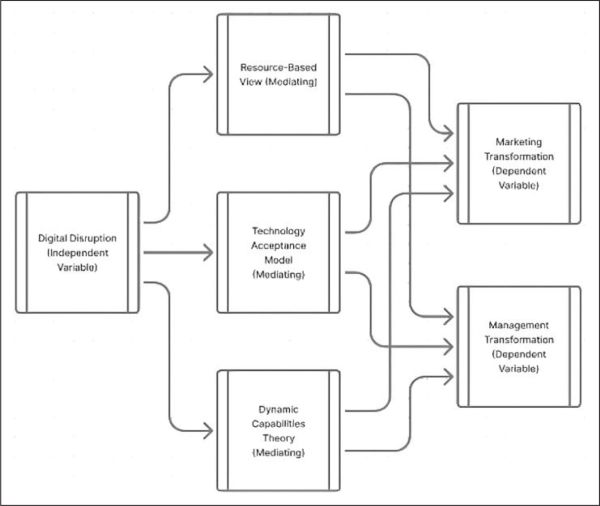
The study integrates the Resource-Based View (RBV), Technology Acceptance Model (TAM), and Dynamic Capabilities to provide a comprehensive understanding of digital transformation. RBV explains how firms leverage internal resources and capabilities for competitive advantage, TAM helps interpret managerial and organizational acceptance of digital technologies, and Dynamic Capabilities highlight how firms adapt and reconfigure resources in rapidly changing digital environments. These theoretical lenses emerged during the data analysis phase, where interview insights consistently reflected themes of technological adoption, capability development, and strategic resource utilization, thereby establishing a clear connection between the empirical findings and the theoretical framework. Figure 1 provides a theoretical framework summary for navigating digital disruptions.
Figure 1.Theoretical Framework Summary for Navigating Digital Disruptions.
Managerial Implications
Digital disruption has significant managerial implications, requiring managers to rethink traditional management approaches and adopt agile, technology-driven strategies. Managers must invest in digital capabilities and emerging technologies while developing strong change leadership to manage resistance and foster a culture of innovation and continuous learning. A customer-centric mindset becomes essential, with digital tools enabling deeper customer insights, personalized offerings, and improved experiences that drive competitive advantage. At the same time, managers must ensure cross-functional collaboration, strengthen cybersecurity and risk governance, and align digital initiatives with sustainability objectives to achieve long-term growth. Effective performance measurement and continuous adaptation are critical for ensuring organizational resilience and sustained success in a digitally transformed business environment.
Directions for Future Research
Future research could examine the long-term effects of digital transformation on marketing and management, analyzing the sustainability of strategies and organizational changes over time. Investigating the role of emerging technologies like blockchain, augmented reality (AR), and the IoT in shaping marketing and management strategies could provide deeper insights into their potential for disruption. Further investigating the ethical concerns associated with digital disruption, such as data privacy, algorithmic bias, and the impact on employment, would add a valuable perspective to the ongoing discourse. By addressing these research gaps, scholars and practitioners can better understand the full scope of digital disruption and develop more effective strategies for the future of marketing and management.
Conclusion
Digital disruption has completely transformed the way organizations approach marketing and management practices. The advent of new and advanced technologies such as AI, IoT, machine learning, data analytics, and automation has opened new vistas for improving efficiency, enhancing customer experience, and innovative business models. However, these digital disruptions also present significant challenges for organizations, including the need for agile strategies, adapting to fast-paced technological shifts over time, flexible systems, managing change and managing a more complex, digitally-savvy workforce. This study highlights that the successful management of digital disruption requires a balanced approach, combining traditional management practices with modern technological innovations. Strategies suggested by the participants in interviews are concerned with customer-centric marketing, real-time data analysis, and digital collaboration tools, which have proven essential for driving transformation. Organizations must focus on skill upgradation of employees by providing opportunities for continuous learning, adapting to their culture, and ensuring that leadership is proactive in embracing change. The study suggests that companies that foster innovation and agility are better positioned competitively in the digital age. Moreover, adopting a holistic cross-functional approach to digital transformation enhances the likelihood of long-term success. These interviews highlight the varied approaches and challenges businesses face in navigating digital disruption. Marketing professionals emphasize data-driven strategies, operations leaders focus on agile management, CEOs prioritize culture and security, and digital strategists advocate for continuous learning. Together, these insights provide an understanding of effective strategies for marketing and management transformation in the digital age. The expected results of the study include a comprehensive framework of strategies that organizations can adopt to thrive in a digitally disrupted environment. The study’s findings converge into four interrelated themes. First, digital disruption emerged as a strategic imperative, reshaping business models and competitive dynamics across sectors. Second, organizational capabilities and leadership readiness were identified as critical enablers in responding effectively to digital change. Third, technology adoption and customer-centric innovation played a pivotal role in enhancing agility and value creation. Finally, challenges related to skills gaps, cultural resistance, and infrastructural constraints moderated the pace and success of digital transformation. Collectively, these themes provide an integrated understanding of how organizations navigate digital disruption while highlighting areas for future research and managerial action. The findings aim to provide actionable insights to enhance organizational resilience, foster innovation, and drive sustainable growth in a competitive digital marketplace.
Declaration of Conflicting Interests
The author declared no potential conflicts of interest with respect to the research, authorship, and/or publication of this article.
Ethical Approval
Not applicable.
Funding
The author received no financial support for the research, authorship, and/or publication of this article.
ORCID iD
Rajeev Kumar https://orcid.org/0000-0003-2217-1145
Berman, S. J. (2012). Digital transformation: Opportunities to create new business models. Strategy & Leadership, 40(2), 16–24.
Bharadwaj, A., El Sawy, O. A., Pavlou, P. A., & Venkatraman, N. (2013). Digital business strategy: Toward a next-generation conceptual framework. MIS Quarterly, 37(2), 471–482.
Bolton, R. N., Chapman, R. G., & Mills, A. J. (2019). Harnessing digital disruption with marketing simulations. Journal of Marketing Education, 41(1), 15–31.
Bughin, J., Catlin, T., Hirt, M., & Willmott, P. (2018). Why digital strategies fail. McKinsey & Company.
Chaffey, D., & Ellis-Chadwick, F. (2019). Digital marketing: Strategy, implementation, and practice. Pearson.
Davenport, T. H., Guha, A., Grewal, D., & Bressgott, T. (2020). How artificial intelligence will change the future of marketing. Journal of the Academy of Marketing Science, 48(1), 24–42.
El Khatib, M. (2024). Digital transformation and digital disruption technologies: The effect of AI and machine learning on managing projects. In H. M. Alzoubi, M. T. Alshurideh, & S. Vasudevan (Eds.), Technology innovation for business intelligence and analytics (TIBIA) (Vol. 147). Springer. https://doi.org/10.1007/978-3-031-55221-2_4
Evans, P., & Forth, P. (2015). Navigating a world of digital disruption. IEEE Engineering Management Review, 43(3), 89–97.
Kabha, R., Kelkar, A. S., & Kamel, A. M. (2023). Digital disruptions and its impact on traditional marketing practices. International Journal of Multidisciplinary Research in Commerce and Economics, 5(5), 128–137.
Kane, G. C., Palmer, D., Phillips, A. N., Kiron, D., & Buckley, N. (2015). Strategy, not technology, drives digital transformation. MIT Sloan Management Review, 14(1), 1–25.
Κυρτσδου, Α. Χ. (2024). Navigating the digital disruption: Agile strategies for regulated global industries in the era of rapid technological changes in international business. https://dspace.lib.uom.gr/handle/2159/31421
Lee, M. T. (2024). Digital disruption and transformation. In Yew Haur Lee (Ed.), Leading in a digitally disruptive world (pp. 33–50). World Scientific Connect.
Masliardi, A., Effendi, M., Ningrum, P. A., Hasnidar, H., & Mala, I. K. (2023). Digital disruption: Exploring the dynamics of marketing in the digital age. SEIKO: Journal of Management & Business, 6(2.1), 421–430.
Mogaji, E. (2025). Digital disruption. In Strategic marketing management. Palgrave Macmillan. https://doi.org/10.1007/978-3-031-99367-1_11
Thompson, E. M., & Turner, E. (2023). Navigating digital transformation: How businesses adapt and thrive in the age of disruption. Research Studies of Business, 1(01), 1–9.
Wang, Z. (2024, May). Navigating the digital future: Strategies for corporate digital transformation. In Proceedings of the 2024 International Conference on Applied Economics, Management Science and Social Development (AEMSS 2024) (pp. 375–381). Atlantis Press.
Westerman, G., Bonnet, D., & McAfee, A. (2014). Leading digital: Turning technology into business transformation. Harvard Business Press.
