
BIMTECH Business Perspectives


Peerzada Mohammad Hanief1 and Vinod Chandra2
1Department of Sociology, University of Lucknow, Uttar Pradesh, India
2Sri JNMPG College, Lucknow, Uttar Pradesh, India

This article is distributed under the terms of the Creative Commons Attribution-NonCommercial 4.0 License (https://creativecommons.org/licenses/by-nc/4.0/) which permits non-commercial use, reproduction and distribution of the work without further permission provided the original work is attributed as specified on the SAGE and Open Access page (https://us.sagepub.com/en-us/nam/open-access-at-sage).
In a global landscape characterised by increased mobility, India has established itself as the largest source country of the international migrant population, with an estimated 18.5 million emigrants in 2024, up from 6.5 million in 1990. By adopting a descriptive and analytical approach, this study offers a reassessment of Indian emigration by leveraging the recent migration data from the United Nations Department of Economic and Social Affairs (UN DESA). The methodological framework integrates two primary analytical techniques: trend analysis to map longitudinal shifts and comparative analysis to evaluate regional variations. In contrast to the existing research that relies on old statistics, this study employs updated numbers to analyse shifts in the magnitude and direction of Indian emigration. The original contribution of the article lies in documenting a dual structural transformation that corridor-specific studies have not captured in detail: a geographical reorientation of Indian emigration away from its historical concentration in the Gulf towards a more dispersed global pattern and a compositional shift from low- and semi-skilled labour towards a skill-intensive profile. Over the past three decades, Indian emigration has experienced a profound structural evolution: what was once a concentrated stream of low- and semi-skilled migration towards the Gulf countries has now evolved into a globalised phenomenon, a transition driven by both a worldwide demand for skilled professionals and the rising individual aspirations within India. The findings of this study demonstrate that as developed nations continue to compete in a global ‘war for talent’ through targeted pathways, Indian migration will increasingly flow towards economies structured to reward, integrate and permanently retain highly skilled labour.
India, Indian emigrants, international migration, GCC countries, North America, Europe, Oceania
Introduction
This study examines how the routes, scale and composition of Indian emigration have changed since 1990, drawing on the 2024 estimates of the United Nations Department of Economic and Social Affairs (UN DESA) on international migrant stock. Two questions guide the analysis. First, which destination regions have gained or lost prominence in the geography of Indian emigration over the past three decades? Second, what structural forces at origin and destination account for the observed shifts in the routes and the skill composition of these flows? These questions matter because India has remained the world’s largest source of international migrants since 2010, and because the answers carry direct implications for migration governance and for skill development policy at home and abroad. The remainder of this introduction situates these questions within the global context and the existing scholarship.
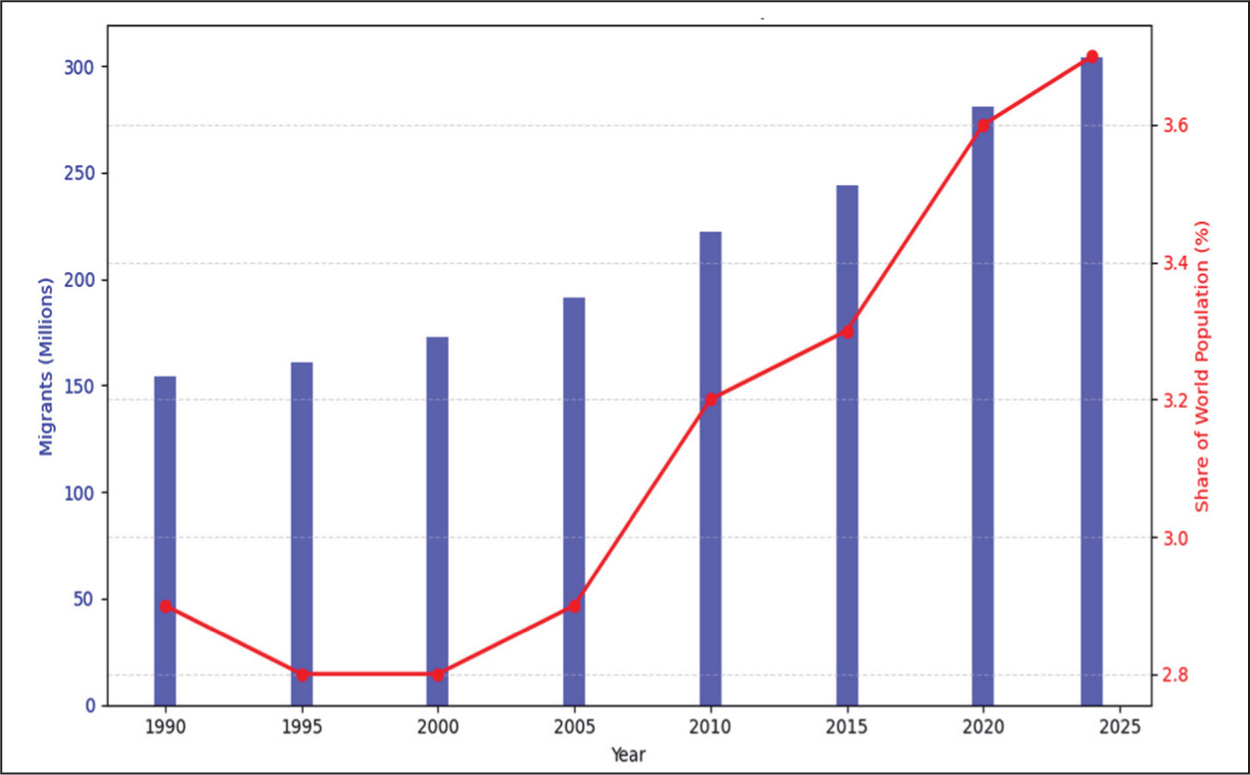
Historically, migration has been a process through which individuals and groups navigate structural constraints, secure upward mobility, or escape insecurity and deprivation. Each year, millions of people move across borders along routes shaped by colonial histories, geopolitical alliances, labour market demands and social networks (de Haas et al., 2020; Massey et al., 1999; Mayblin & Turner, 2021). The global migrant population is highly heterogeneous, encompassing both highly skilled professionals and those experiencing intersecting forms of deprivation (Anderson, 2013; Anthias, 2012). Although the proportion of international migrants in the world population has grown only modestly, their absolute number has nearly doubled, from 153.9 million in 1990 to 304 million in 2024 (Figure 1). This pattern suggests that migration is not simply a demographic phenomenon, but a process embedded in political, economic and social structures that facilitate or restrict mobility (Czaika & de Haas, 2013).
Despite India’s growing prominence in global migration debates, existing scholarship has largely examined Indian emigration through state-level surveys or specific thematic and corridor-based lenses (Bhagat et al., 2013; Khadria, 2001; Rajan, 2004, 2024; Zachariah et al., 2001a, 2001b). As a result, how the overall scale and geography of Indian emigration have shifted over the past three decades has received less attention. This study makes four contributions to this gap. First, drawing on the UN DESA (2024) International migrant stock dataset, it offers a longitudinal analysis of the magnitude and spatial distribution of Indian emigration from 1990 to 2024, confirming India’s standing as the world’s largest source country of international migrants. Second, it situates observed shifts in the scale and direction of emigration within the existing literature, offering explanations for these changes across time and region. Third, the study identifies a dual structural transformation in Indian emigration: a geographical reorientation away from historical concentration in the Gulf towards a more globally dispersed pattern, and a compositional shift in the migrant labour force from predominantly low- and semi-skilled workers towards a more diversified, skill-intensive profile. Fourth, it generates evidence that can meaningfully inform migration governance, initiatives for skill development, and bilateral labour mobility agreements, each of which shapes the future trajectory of Indian emigration. Taken together, these contributions integrate updated data with structural and policy analysis to advance our understanding of India’s place in the contemporary global migration system.
Since the United Nations began tracking the origins of international migrants in 1990, India has consistently ranked among the largest sources of emigrants globally. By 2010, India had surpassed Mexico to become the world’s largest emigrant-sending country (Table 1). The total number of Indian international migrants increased from nearly 6.6 million in 1990 to 7.8 million in 2000, 12.3 million in 2010, 16.5 million in 2020 and 18.5 million in 2024. This significant outflow is not merely a matter of numerical growth; it also involves the movement of social, cultural and intellectual capital. Research indicates that international migration, particularly from countries such as India with a substantial global presence, facilitates the exchange of knowledge, ideas and practices between countries of origin, transit and destination (Pandey et al., 2022; Sahay, 2009; Tejada, 2016). Singh and Krishna (2015) provide empirical evidence that the migration of skilled professionals from India facilitates brain circulation, thereby enhancing technological and intellectual diffusion across sending and receiving countries. This finding aligns with the framework proposed by Gaillard et al. (2015), which conceptualises return and circular migration as key mechanisms for the transfer of scientific knowledge and practices, transforming migration from a unidirectional ‘brain drain’ into a dynamic process of transnational knowledge flow. Expanding on this perspective, Friesen and Collins (2016) introduce the notion of brain chains, demonstrating how Indian migrants and intermediary organisations mediate complex flows of ideas and practices across origin, transit and destination contexts.
| Year | % Share and Number (Million) of Indian Emigrants | % Share and Number (Million) of Mexican Emigrants |
| 1990 | 6.6 (4.3%) | 4.6 (2.9%) |
| 2000 | 7.8 (4.4%) | 9.3 (5.3%) |
| 2010 | 12.3 (5.5%) | 12.1 (5.4%) |
| 2020 | 16.5 (6.0%) | 11.4 (4.1%) |
| 2024 | 18.5 (6.1%) | 11.6 (3.8%) |
Source: Compiled by the author based on UN DESA, 2024 data.
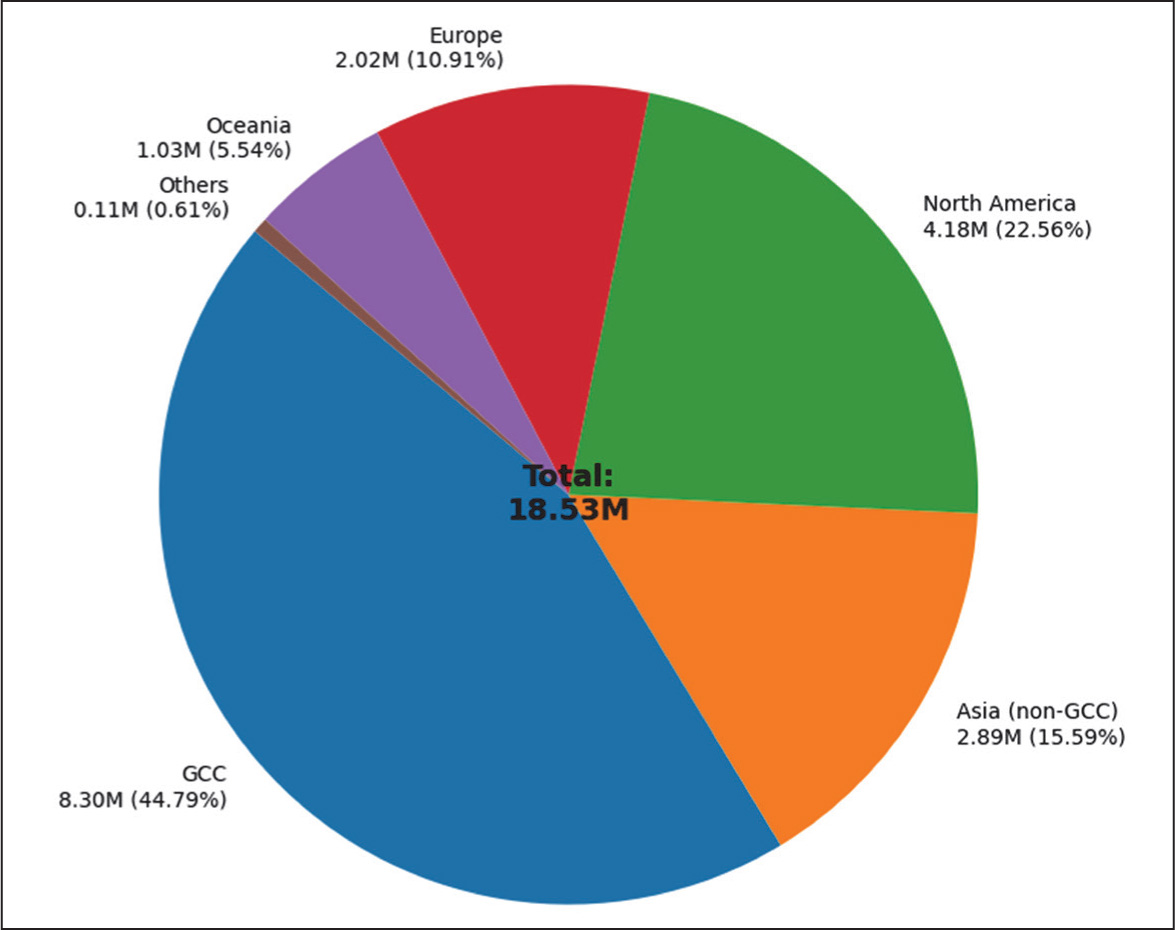
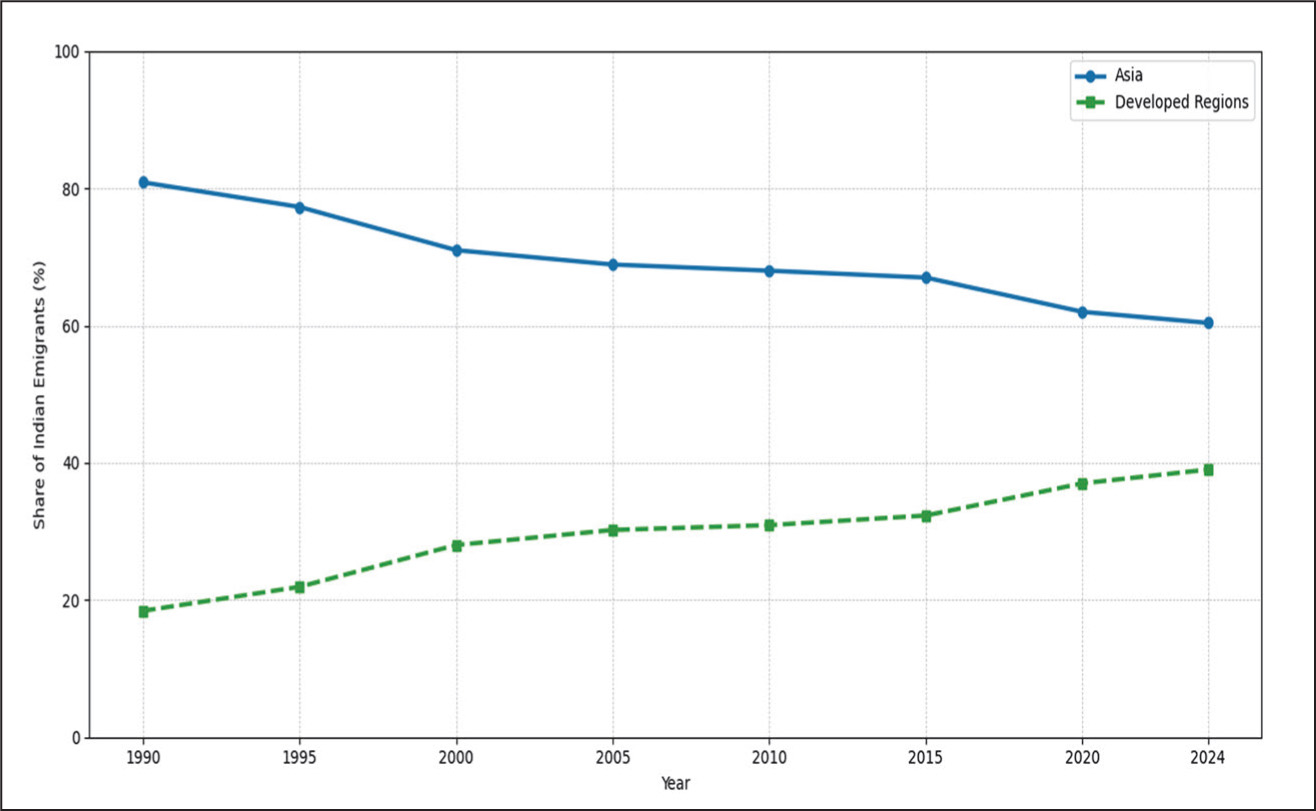
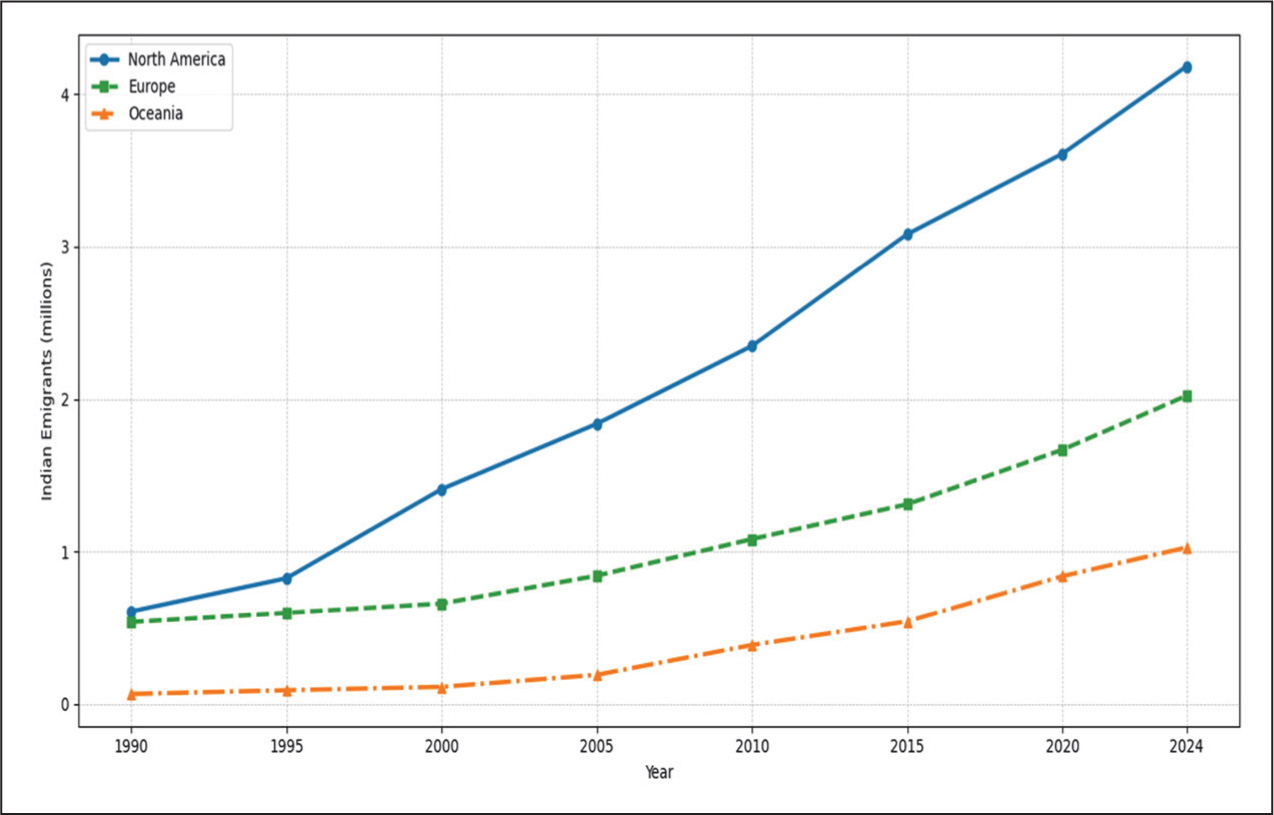
Indian emigrants are globally dispersed, with large concentrations in the Gulf Cooperation Council (GCC) countries, North America, Europe and Oceania (Figure 2). Labour migration to the Gulf countries continues to dominate among low-skilled and semi-skilled workers (Arokkiaraj & Irudaya Rajan, 2025; Naufal et al., 2017; Rajan & Suresh, 2017), whilst highly skilled professionals migrate predominantly to developed countries such as the United States, Canada, the United Kingdom and Australia (Khadria, 2006, 2008; Khadria et al., 2022; OECD, 2025). Indian emigration patterns have undergone substantial geographical reorientation since 1990. The data indicate that, whilst more than 80% of Indian emigrants resided in Asia in 1990, primarily in the GCC countries, the subsequent three decades witnessed a shift towards developed regions (Khadria et al., 2022; Sasikumar & Hussain, 2008). Of the total number of Indian emigrants globally, the proportion in North America increased from 9.2% (0.6 million) in 1990 to 22.6% (4.2 million) in 2024, driven by growing demand for skilled workers and science, technology, engineering and mathematics (STEM) professionals (Khadria, 2008; Picot & Hou, 2020). Data from the Migration Policy Institute (MPI) (Batalova & Greene, 2024) show that, in FY 2023, Indian nationals obtained green cards either as immediate relatives of US citizens (41%) or as other family members of citizens (19%). However, they were also disproportionately concentrated in skill-based pathways, with 37% obtaining green cards through employment-based preferences, more than double the corresponding share among all new lawful permanent residents in the same period. The share of Indian emigrants in Europe rose from 8.2% (0.5 million) to 10.9% (2.0 million) over the same period, reflecting EU labour market integration and student mobility (Khadria, 2006; Williams, 2019). The most dramatic growth occurred in Oceania, where the Indian emigrant stock rose from approximately 66,000 in 1990 to over one million in 2024, increasing the Indian share of the region’s total migrant population from 1.4% to 10.4%, a rise attributable to points-based immigration systems in Australia and New Zealand (Mehdi et al., 2019; Volodin, 2022). This shift represents a transition from temporary labour migration within Asia to skill-selective and more permanent migration to OECD destinations (Bhalla, 2013; Boucher, 2020; Raymer et al., 2022). Thus, India’s consistent presence among the top origin countries of international migrants since 1990 underscores its centrality in global migration systems. As the world becomes more interconnected, migration patterns emerging from countries such as India will continue to shape not only the social and economic landscapes of origin and destination countries, but also the wider global order.
Data Sources and Analysis
The geographic focus of this study was determined by the global distribution of Indian emigrants, specifically targeting the regions that accommodate the overwhelming majority of this population. According to the data from the UN DESA, out of an estimated 18.53 million Indian emigrants worldwide, approximately 18.43 million (over 99%) reside and work in Asia, North America, Europe and Oceania. Within Asia, the GCC countries alone host 8.3 million Indian emigrants. The GCC countries, North America, Europe and Oceania therefore constitute the dominant migration corridors examined in this study, whilst the analysis of the remaining Asian countries, most notably Pakistan, contextualises the regional redistribution. By focusing on these primary migration corridors, the study captures the macro trends and structural dynamics defining Indian emigration since 1990, whilst excluding marginal flows that would not significantly impact the findings.
The study adopts a descriptive and analytical approach, synthesising secondary data with an extensive review of existing migration literature. The methodological framework integrates two primary analytical techniques: trend analysis, which maps longitudinal shifts, and comparative analysis, which evaluates regional variations. This study uses data drawn from the 2024 UN DESA dataset on international migrant stock. This repository provides 5-year interval estimates spanning 1990-2024, disaggregated by origin, destination and sex across 233 countries and regions. All indicators reported in this article were computed by the authors from the origin and destination matrices of this dataset. For each observation year, the stock of Indian emigrants in a given destination country or region was expressed as a percentage of the total Indian emigrant stock in that year, so that movements in shares capture the changing geography of emigration independently of overall growth. Changes over time are summarised through absolute increments and compound annual growth rates for the period 1990-2024, allowing direct comparison of the pace of expansion across regions. The comparative dimension of the analysis benchmarks Indian emigration against other leading source countries, including Mexico at the global level and China and the United Kingdom within Oceania, in order to situate the Indian experience within broader migration dynamics. Each observed shift is then interpreted in relation to the explanatory literature on labour demand, immigration policy regimes and migrant networks, linking statistical patterns to their structural determinants. The known limitations of the dataset, including undercounting and differences in national reporting practices, are acknowledged in the limitations section. By leveraging this latest dataset, the present study addresses a significant gap in the existing literature, which has often relied on older data on international migrant stock. The use of updated data facilitates a more rigorous assessment of the magnitude, trajectories and emerging patterns of Indian emigration.
Results and Discussion
India as an Emigration Country
India’s status as a major emigration country is deeply rooted in its colonial past (Sadiq & Tsourapas, 2024) and has been dynamically shaped by globalisation and labour market transformations (Agarwala, 2022). The migration of Indian labourers during the colonial period laid the foundation for the extensive Indian diaspora observed today. Following the abolition of slavery in the British Empire in 1833-1834, a substantial demand for low-cost labour emerged across British colonies. To fulfil this demand, the British colonial administration instituted the indentured labour system (just after the abolition of slavery), a semi-coercive arrangement that operated between the extremes of slavery and free labour (Hui & Kambhampati, 2025; Jain, 1989). Under this system, a large number of Indian labourers were transported to colonies such as South Africa, Mauritius, Trinidad and Tobago, Guyana and Fiji (Khadria, 2013; Mishra, 2009; Sharma, 2024).
According to recent estimates by the MEA, the total overseas Indian population is estimated at 35.4 million, comprising 15.8 million NRIs and 19.6 million PIOs. Although NRIs are Indian passport holders residing temporarily or permanently abroad, PIOs include individuals who are not Indian citizens but whose ancestry can be traced to India. The size and regional distribution of this diaspora population are examined in detail by Jain and Prasad (2023). India’s emigrant population exemplifies transnational identities shaped by continuous interaction between origin and host societies. Migrants navigate multiple cultural, social and economic spaces, contributing to what Appadurai (1996) calls the ‘ethnoscapes’ of globalisation. Transnational migration theory provides a valuable analytical framework for understanding how migrants simultaneously maintain embeddedness in both countries of origin and destination, creating what Levitt and Glick Schiller (2004) describe as ‘transnational social fields’. These cross-border networks, sustained through kinship, technology, finance and identity, play a pivotal role in facilitating and reinforcing successive migration waves.
In the Indian context, such dynamics were structurally catalysed by the economic liberalisation reforms of the early 1990s, which opened the Indian economy to global capital flows and intensified outward migration, particularly among highly skilled professionals (Khadria, 2001; Parida & Raman, 2024). This period marked a decisive shift in India’s emigration profile: whilst earlier migrations were often associated with indentured labour or low-skilled work, post-liberalisation mobility increasingly involved engineers, doctors and IT professionals seeking opportunities in countries such as the United States, Canada, the United Kingdom and Australia. This transformation is often characterised in academic discourse as ‘brain drain’, or the loss of human capital from sending countries to more developed receiving nations (Docquier & Rapoport, 2006). However, recent literature has re-evaluated this narrative, suggesting a more dynamic process of ‘brain circulation’, in which transnational diaspora members actively contribute to the source country’s development through knowledge transfer, return migration, philanthropic activity and remittances (Docquier & Rapoport, 2012; Kapur, 2002, 2010; Saxenian, 2006; Tejada & Bhattacharya, 2014; Varghese, 2021). As global migration governance has evolved, sending states such as India have become increasingly active participants in managing and harnessing their diasporas, shaping what Gamlen (2008) characterises as the rise of the ‘emigration state’, a state that uses administrative and symbolic tools to mobilise its emigrant population for national development. Through initiatives such as Pravasi Bharatiya Diwas and Overseas Citizenship of India (OCI), the Indian government has created formal and informal ties with its diaspora, treating emigrants as assets for national development and soft power diplomacy (Kapur, 2010; Ragazzi, 2014). The subsequent global spread of formal diaspora institutions, traced comprehensively by Gamlen (2019), confirms that India’s approach forms part of a wider transformation in the governance of emigration. Thus, Indian emigration in the current era reflects not only individual aspirations and labour market logics, but also the geopolitical strategies of the state.
Emigration Trends from India to GCC Countries
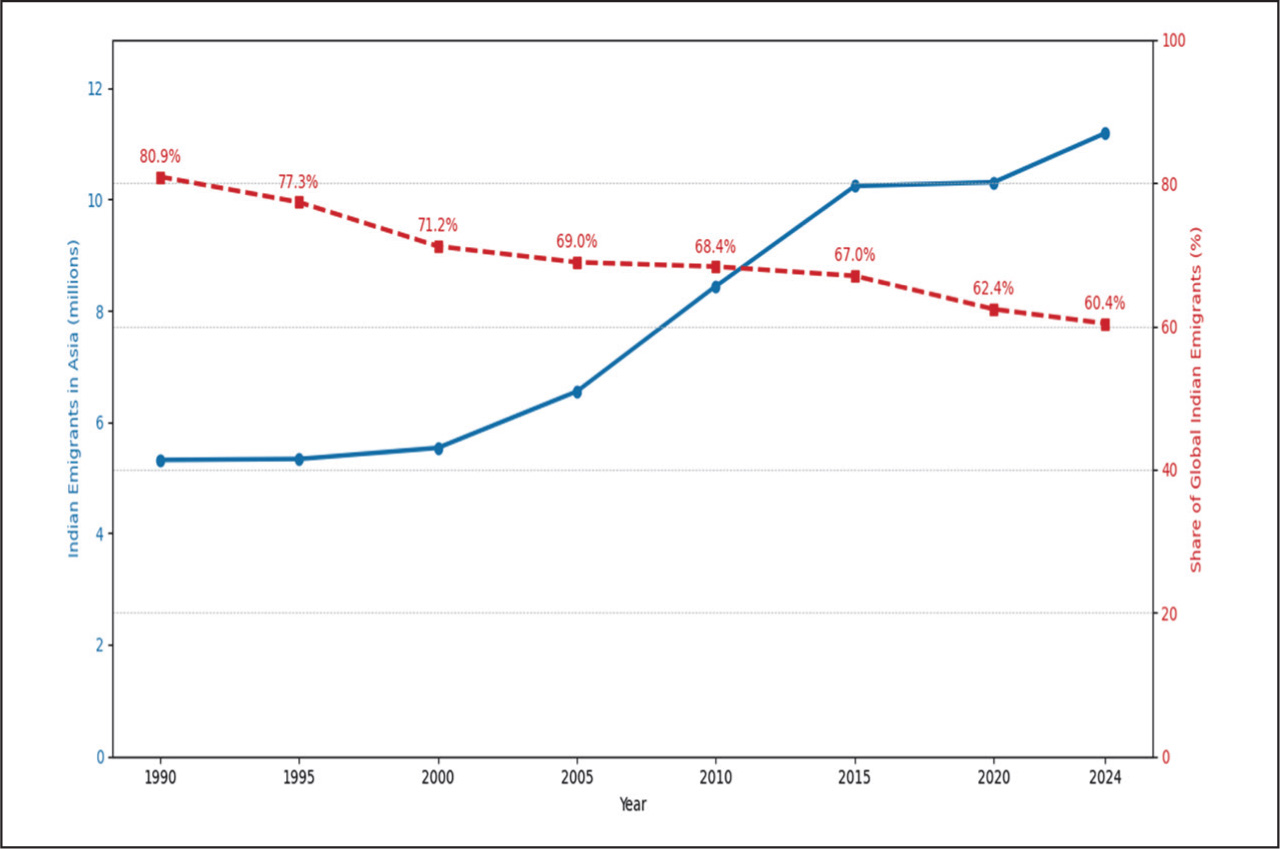
Over the past few decades, Indian emigration patterns have undergone significant shifts, particularly in terms of destination countries and regions. Data for 1990-2024 illustrate a marked change in the spatial distribution of Indian emigrants. Although the absolute volume of Indian emigrants within Asia expanded from 5.3 million to 11.2 million over this period, their relative concentration within the region declined. Specifically, the proportion of Indian emigrants residing in Asia fell from approximately 81% of all international Indian emigrants in 1990 to 60.4% in 2024 (Figure 3), signalling an increasing diversification of destinations within and beyond Asia.
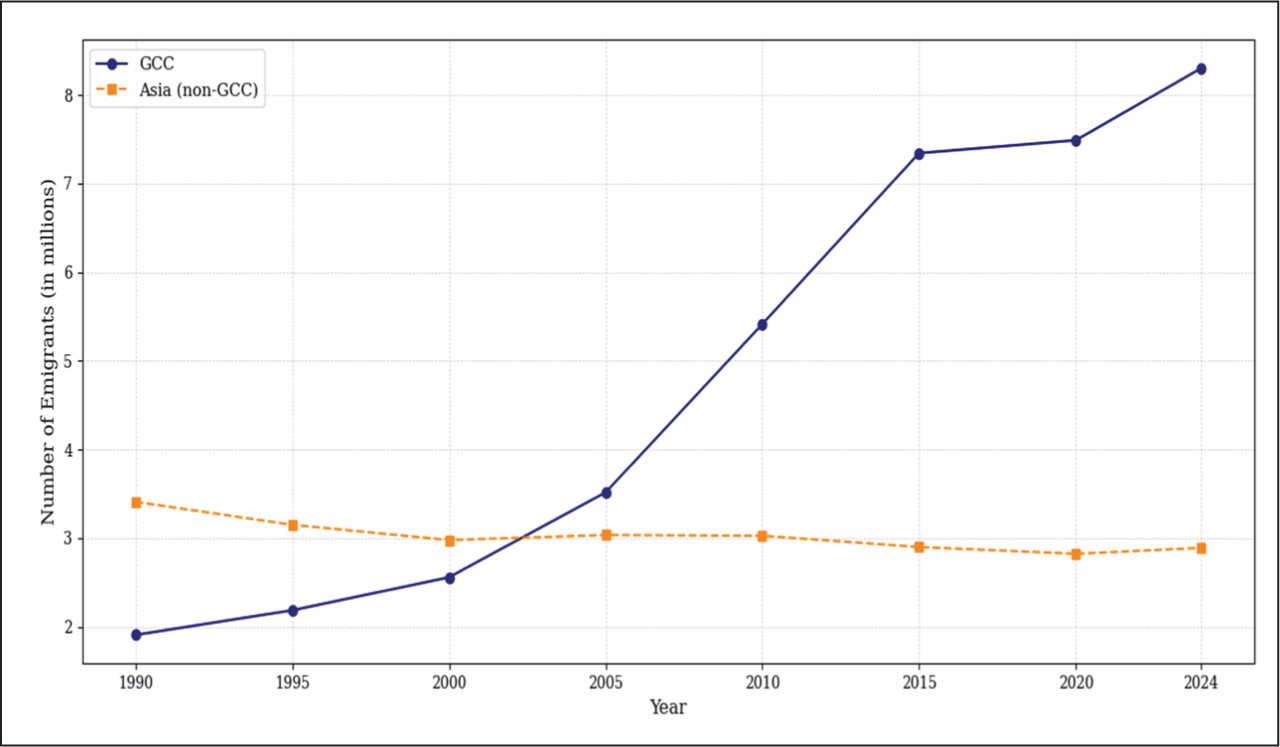
One of the most noteworthy trends within Asia is the growing prominence of the GCC countries, including the United Arab Emirates, Saudi Arabia, Qatar, Bahrain, Kuwait and Oman. Consisting primarily of low-skilled workers in the construction and domestic services alongside steady movement of skilled professionals, including doctors and nurses (Chanda & Sreenivasan, 2006; Khadria, 2006), the share of Indian emigrants to these nations surged substantially from nearly 36% (1.9 million) of the total Indian emigrant stock in Asia in 1990 to an impressive 74.2% (8.3 million) in 2024 (see Figure 4). This sharp increase in low-skilled labour migration from India is driven by various distress factors, including unemployment, pursuit of higher wages and poverty (Azeez & Begum, 2009; Noushad et al., 2022; Parida & Raman, 2024). The GCC countries have long relied on foreign labour, particularly from South Asia, to meet their labour demands in low-wage sectors (Kapiszewski, 2016; Wagle, 2024). As such, the Indian workforce, which has been increasingly equipped with technical and vocational skills, finds ample opportunities in the Gulf region.
In contrast, whilst the share of Indian emigrant stock in the GCC region grew, the proportion of Indian emigrants in other Asian countries fell sharply from 64% (3.4 million) in 1990 to only 25.8% (2.9 million) in 2024 (see Figure 4). This decline can be partially attributed to the weakening of historical migration as well as the reduced social networks and strained political relations in the region.
Specifically, the erosion of cross-border mobility between India and Pakistan, following the partition of the subcontinent and decades of political tension, has been a crucial factor in reducing emigration to Pakistan. It is also generally assumed that the subsequent generations might have weaker ties with relatives in Pakistan than the earlier generations. In 1990, nearly 53% of Indian emigrants were heading to Pakistan, a number that has since plummeted to 14.3% in 2024 (see Table 2). This change in migration patterns underscores the significant role of geopolitical factors in shaping migration trends (Hyndman, 2012; Punathil, 2025).
| Country/Year | 1990 | 1995 | 2000 | 2005 | 2010 | 2015 | 2020 | 2024 |
| United Arab Emirates | 8.5 | 12.3 | 16.0 | 19.2 | 25.6 | 26.6 | 27.7 | 29.0 |
| Saudi Arabia | 15.7 | 17.3 | 17.5 | 18.3 | 17.9 | 18.7 | 18.3 | 17.4 |
| Kuwait | 6.9 | 6.3 | 7.4 | 7.5 | 7.9 | 9.4 | 10.8 | 11.0 |
| Bahrain | 1.1 | 1.4 | 1.6 | 2.3 | 2.9 | 2.7 | 2.9 | 2.9 |
| Qatar | 0.03 | 0.04 | 0.06 | 2.9 | 6.1 | 7.8 | 6.6 | 6.5 |
| Oman | 3.4 | 3.5 | 3.5 | 3.2 | 3.3 | 6.2 | 3.1 | 7.1 |
| Pakistan | 53.0 | 44.3 | 37.9 | 30.5 | 23.0 | 16.6 | 15.4 | 14.3 |
| Nepal | 6.9 | 9.6 | 9.8 | 7.8 | 5.4 | 4.3 | 4.1 | 3.6 |
| Singapore | 0.9 | 1.3 | 1.9 | 2.2 | 3.1 | 3.1 | 3.2 | 3.3 |
| Other countries | 3.5 | 3.9 | 4.3 | 6.1 | 4.8 | 4.6 | 7.9 | 4.9 |
| Asia total | 100 | 100 | 100 | 100 | 100 | 100 | 100 | 100 |
Source: Compiled by the author based on UN DESA, 2024 data.
Within the GCC countries, Indian emigration patterns have undergone an internal reorientation over the past three decades. Until 2000, Saudi Arabia remained the primary destination for Indian migrants in the region. However, after 2000, the United Arab Emirates emerged as the dominant host country for Indian emigrants not only within Asia but also globally. This shift from Saudi Arabia to the UAE can be attributed to labour market restructuring and the diversification of economic opportunities in the Gulf (De Bel-Air, 2015; Suri & Kumar, 2020). The realignment also aligns with the UAE’s sectoral expansion into urban, service-led industries, vis-à-vis Saudi’s increasingly restrictive labour market and nationalisation (Saudisation) (De Bel-Air, 2014; Suri & Kumar, 2020). On the other hand, other GCC countries such as Qatar, Bahrain and Oman have also shown increasing trends but hosted less than 10% of the Indian emigrant population throughout the 1990-2024 period. Wagle (2024) underscores that the sustained and predictable flow of remittances is the primary motivation for Indian migration to the GCC region.
Jaeck (2022) further highlights this shift by arguing that GCC countries, which were initially more reliant on Arab migrants from culturally and linguistically similar countries such as Egypt, Jordan, Libya, Morocco, Palestine and Tunisia, gradually redirected their recruitment policies towards South Asia. GCC states have had social and political reservations about workers from neighbouring Arab countries and have also viewed South Asian migrants as more willing to work at lower wages and less likely to pose political challenges than their Arab counterparts (Gardner, 2011; Naufal, 2011; Shah, 2013). In addition to this, various studies (Chandramalla, 2022; Parida & Raman, 2024; Rajan & Saxena, 2019; Shalizi & Kumar, 2024) note that labour migration from India to the GCC countries is dominated by low-skilled, unskilled and semi-skilled migrants, with unemployment as the most commonly cited reason for migration.
Survey-based evidence points in the same direction: successive rounds of the Kerala Migration Survey show that unemployment and the search for higher earnings are the most frequently reported motives for migration to the Gulf (Rajan, 2024; Zachariah et al., 2001a), and studies of low-skilled migration to the Middle East reach similar conclusions (Rajan & Saxena, 2019). Taken together, these findings indicate that the migration of a significant proportion of Indian emigrants to the GCC countries is driven primarily by unemployment and limited earning opportunities in their places of origin, combined with restricted demand for low-skilled labour in developed regions such as North America, Europe and Oceania. This corridor thus represents the persistence of an older, employment-driven pattern of Indian emigration, against which the skill-driven reorientation documented in the following sections stands out.
Although the post-1990 period has witnessed a relative decline in the share of Indian emigration towards Asia, there has been a corresponding and substantial increase in the flow of Indian emigrants to developed regions such as North America, Europe and Oceania (see Figure 5). The differential pace at which Indian emigration grew across regions is highly instructive. Between 1990 and 2024, the Indian emigrant population grew at an annual rate of approximately 5.8% in North America, 8.4% in Oceania and 4.0% in Europe, compared with 4.4% in the GCC countries and an actual decline in the rest of Asia over the same period. This pattern is not coincidental: the destinations where Indian emigration grew at a relatively higher rate are precisely those that primarily attract skilled professionals. Khadria et al. (2022) and Walton-Roberts (2015) support this view, arguing that this migration stream consists largely of skilled professionals in STEM, including health professionals. These findings support the view that the changing geography of Indian emigration is closely associated with changes in the composition of emigrants: where Indians are moving has changed because who is moving has changed. Developed countries have institutionally reinforced this directionality by designing policies to attract skilled workers in response to demographic ageing and technology-related labour shortages, with the international mobility of highly skilled workers growing in scale and complexity as more economies participate in research, development and innovation activity (OECD, 2008). Therefore, the shift in the direction of migration can be attributed to increased demand for highly skilled labour, together with skill-selective immigration policies (Khadria, 2006; Kipp, 2025) designed to attract skilled workers in developed countries, especially in sectors such as information technology, healthcare and academia (Cerna, 2010; Kapur & McHale, 2005; Khadria, 2008; Ray, 2013; Singh, 2014). The shift can also be explained by differences in access to permanent residency. In developed countries, migrants often have opportunities to obtain citizenship and eventually reunite with their families. In stark contrast, migration to the GCC countries remains largely temporary, with little or no provision for permanent residency or formal avenues for family reunification (Bhalla, 2013; Naujoks, 2009). Parida and Raman (2024) further argue that higher skill levels may have strengthened aspirations among young migrants to seek better job opportunities in the United States, Canada, Europe and other developed countries.
North America
The rise of a more educated, middle-class population, along with India’s emergence as a global IT hub, has facilitated greater skill-based migration to developed economies (Parida & Raman, 2024; Singh, 2014). This shift, as indicated by Beine et al. (2001, 2008), can be linked to the ‘human capital theory’, which posits that individuals with higher levels of education and skills will tend to migrate to regions that offer better returns on their qualifications. As indicated in Figure 6, a further disaggregation of Indian emigration trends to developed regions between 1990 and 2024 gives us a more detailed picture. The Indian emigrant stock in North America increased from approximately 0.6 million to 4.2 million, largely driven by migration to the United States and Canada. Similarly, Europe experienced a rise in Indian emigrants from 0.5 million to 2.0 million, whilst Oceania, primarily Australia and New Zealand, saw Indian emigrant numbers increasing from 66 thousand to over one million during the same period.
A more granular analysis of Indian emigration to North America reveals a marked concentration in the United States and Canada, with migration flows significantly favouring the United States over time (see Table 3). In 1990, the United States accounted for approximately 73% of Indian emigrants in the North American region, whilst Canada accounted for approximately 27%. By 2024, the US share had modestly increased to 75.5%, whereas Canada’s share declined to 24.3%. This is likely influenced in part by Canada’s position as a secondary migration destination in the North American region (Reitz, 2013). Migration from India to Canada (particularly from Punjab) was historically dominated by low-skilled labourers, including truck drivers, taxi drivers and agricultural workers (Oberai & Singh, 1980). However, from the 1990s onwards, India experienced an educational boom, leading to a surge in highly qualified professionals migrating to the United States facilitated by the H-1B visa programme and the US’s growing reliance on global tech talent (Kapur & McHale, 2005; Saxenian, 2006; Singh, 2014; Volodin, 2022). Indian migrants in the United States today are one of the most highly educated ethnic groups, with over 77% holding at least a bachelor’s degree (31%) or an advanced degree (45%) (Im, 2025) and significant representation in STEM and healthcare sectors (Khadria et al., 2022). Moreover, whilst Canada also shifted to a points-based immigration system favouring skilled migrants, it initially attracted fewer IT professionals compared to the United States due to differences in labour market demand and sectoral development (Reitz, 2013).
| Country/Year | 1990 | 1995 | 2000 | 2005 | 2010 | 2015 | 2020 | 2024 |
| USA | 73.2 | 72.3 | 78.7 | 77.2 | 76.6 | 77.3 | 75.9 | 75.7 |
| Canada | 26.8 | 27.6 | 21.3 | 22.7 | 23.3 | 22.7 | 24.0 | 24.3 |
| Others | 0 | 0.1 | 0 | 0.1 | 0.1 | 0 | 0.1 | 0 |
| North America total | 100 | 100 | 100 | 100 | 100 | 100 | 100 | 100 |
Source: Compiled by the author based on UN DESA 2024 data.
Employment trends among immigrants in Canada since the 1970s reveal a persistent paradox, as indicated by Frenette and Morissette (2005) and Reitz (2007). Despite the increasing proportion of immigrants with higher skill levels, their representation in skilled occupations remains disproportionately low (Picot & Hou, 2020). Furthermore, earnings among skilled immigrants relative to the native-born population have declined markedly over time (Reitz, 2007, 2013). This is further supported by Crea-Arsenio et al. (2022), who argue that the decline in outcomes for immigrants, particularly those with university degrees, is frequently linked to the underutilisation of skills. This process is further exacerbated by rising demand for labour in low-wage sectors, where many highly skilled immigrants are disproportionately employed (Reitz et al., 2014). However, despite the relatively smaller presence of Indian immigrants in Canada compared to the United States, Canada remains an important destination for skilled migrants because of its immigration reforms, permanent residency pathways (IRCC, 2026) and active recruitment of international students (Alboim & Cohl, 2012). These patterns address the second research question of this study: North America has become the main destination of India’s skill-intensive emigration, even as the evidence of skill underutilisation in Canada shows that skill-selective admission does not automatically translate into appropriate employment outcomes.
Europe
Within the group of developed regions, Europe has emerged as the second most prominent destination for Indian emigrants after North America. The Indian diaspora in Europe has increased significantly, growing fourfold from approximately 0.5 million in 1990 to over two million in 2024 (UN DESA, 2024). Notably, the Indian emigrant population in Europe reached only one million by 2010, indicating that the surge in migration to Europe is a relatively recent phenomenon, driven largely by skilled professionals (Sinha, 2026; Tejada & Bhattacharya, 2014).
This trend reflects evolving labour market dynamics within Europe, particularly the increasing demand for highly skilled workers. At the same time, member states of the European Union (EU) have confronted demographic challenges such as a declining working-age population and skills mismatches (Mehdi et al., 2019). In response, the EU has adopted more skill-selective immigration frameworks to strengthen its human capital base and global competitiveness. One such initiative is the EU Blue Card scheme, launched in 2009, which serves as a demand-driven work and residence permit aimed at harmonising high-skilled immigration policy across the EU (Khadria, 2019). In addition to offering residence to skilled migrants, the scheme aims to attract and retain talented workers to enhance the EU’s competitiveness and support economic growth (Rajan, 2019). José Manuel Barroso, the former president of the European Commission, observed that labour migration into Europe boosts our competitiveness and therefore our economic growth. It also helps tackle demographic problems resulting from our ageing population (EU Blue Card Network, n.d.). This policy shift has generated new relocation opportunities for skilled Indian professionals, particularly in sectors such as IT, finance, management, academia and research (Tejada & Bhattacharya, 2014).
A further breakdown of Indian emigration to Europe reveals that countries such as the United Kingdom, France, Germany and Italy have consistently attracted the highest number of Indian migrants within the region. Although the United Kingdom has historically remained the top European destination for Indian emigrants because of colonial ties, language familiarity and established diaspora networks (Khadria, 2002; Singh & Sirkeci, 2021), its dominance within the European landscape has weakened over time, declining from 75.3% in 1990 to 51.7% in 2024 (see Table 4). These numbers indicate that Indian immigrants in Europe have increasingly moved to other countries within the EU (Mehdi et al., 2019). The eastward expansion of the EU in 2004 further enabled Indian migrants to explore new destinations within Europe.
| Country/Year | 1990 | 1995 | 2000 | 2005 | 2010 | 2015 | 2020 | 2024 |
| United Kingdom | 75.3 | 72.4 | 70.0 | 66.7 | 64.7 | 62.4 | 56.7 | 51.7 |
| France | 3.9 | 4.4 | 4.9 | 5.0 | 4.4 | 4.1 | 3.7 | 3.3 |
| Germany | 6.0 | 6.7 | 6.1 | 5.3 | 4.8 | 6.6 | 9.1 | 13.2 |
| Spain | 0.6 | 0.9 | 1.2 | 2.4 | 3.3 | 2.8 | 3.3 | 3.3 |
| Italy | 1.8 | 2.7 | 3.9 | 6.9 | 9.1 | 9.9 | 10.0 | 9.2 |
| Ireland | 0.1 | 0.2 | 0.4 | 0.9 | 1.5 | 1.5 | 2.5 | 3.5 |
| Other countries | 12.3 | 12.7 | 13.5 | 12.8 | 12.2 | 12.7 | 14.7 | 15.8 |
| Europe total | 100 | 100 | 100 | 100 | 100 | 100 | 100 | 100 |
Source: Compiled by the author based on UN DESA, 2024 data.
In contrast, Germany and Italy have experienced a substantial increase in the number of migrants from India. In 1990, Indian migrants in Italy and Germany accounted for 1.8% and 6% of the Indian emigrant population in Europe, respectively. By 2024, these numbers had increased to 9.2% and 13.2% (see Table 4), reflecting changes in both migration policies and labour demands within these countries (Volodin, 2022). Germany, in particular, implemented targeted policy initiatives such as the Green Card scheme (2000-2005) to attract IT professionals in response to a growing digital skills shortage (Naujoks, 2009). Italy, on the other hand, has become a key destination for India’s low- and semi-skilled workers, especially in the agriculture and dairy sectors. Migrants, particularly from the Punjab region, have taken advantage of informal migration networks and employment opportunities in rural Italian provinces, often navigating legal and institutional barriers (Sahai & Lum, 2013). The European evidence reinforces the central finding of this study. Destination diversification is proceeding alongside skill selectivity, with Indian migrants entering both high- and low-skilled segments of European labour markets.
Oceania
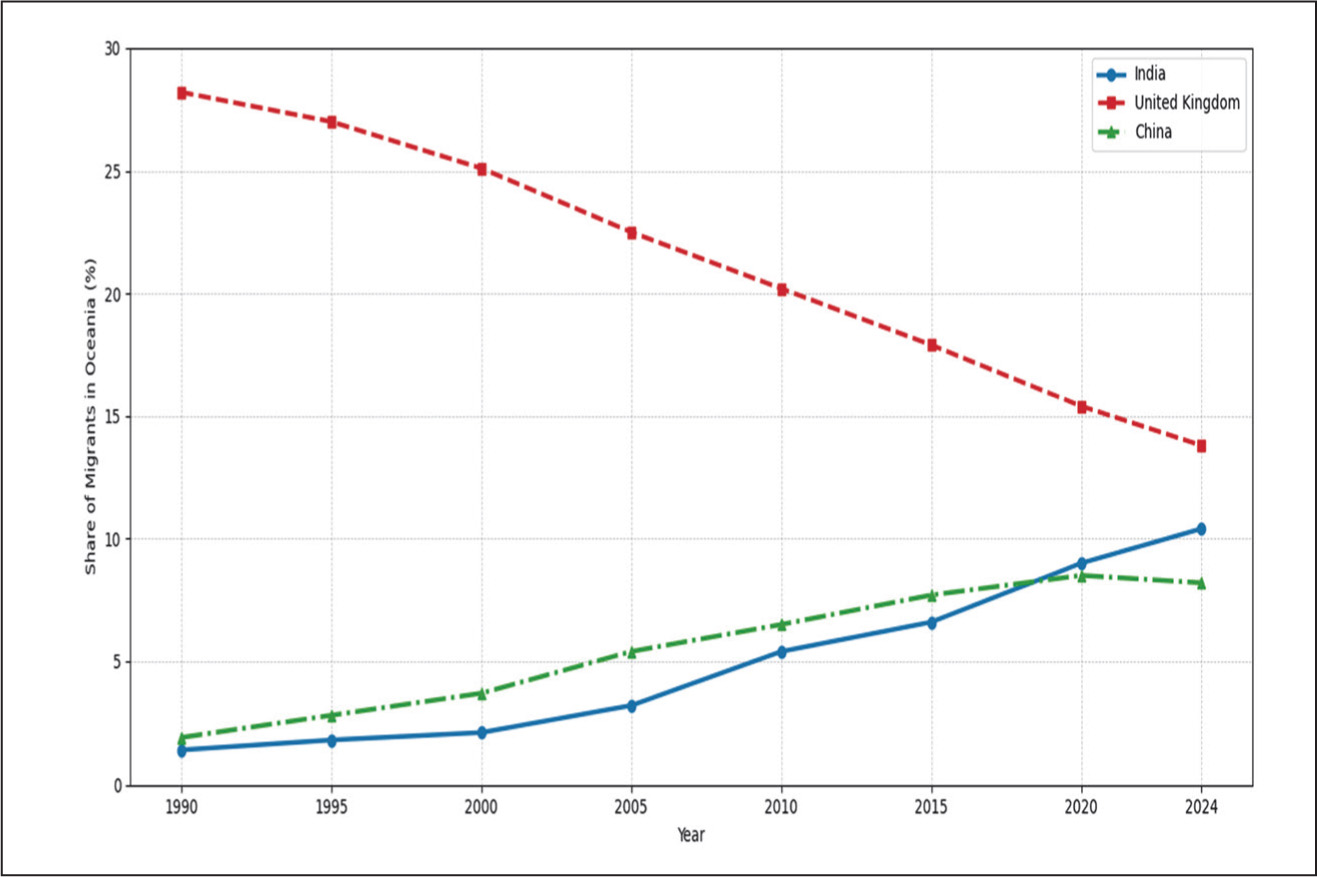
Since the 1990s, Indian emigration to Oceania, particularly to Australia and New Zealand, has increased notably. In 2024, 96.7% of international migrants in Oceania resided in just two countries: Australia and New Zealand (UN DESA, 2024). The data further indicate that Oceania currently hosts approximately 9.9 million international migrants, and India is now the second-largest source country after the United Kingdom in both Australia and New Zealand. China has also shown an increasing trend of emigration towards Oceania, although its share has begun to decline since 2015. As of 2024, over one million Indian emigrants reside in Oceania, accounting for more than 10% of the region’s total migrant population, a significant increase from 1.4% (66,000) in 1990. By comparison, the share of Chinese migrants in Oceania was 8.2% in 2024, up from 1.9% in 1990 (see Figure 7). As the growing immigrant population is primarily hosted by Australia and New Zealand, this study focuses on these two countries in particular.
The significant increase in the proportion of Indian emigrants within these two countries has had a bearing on the shift in immigration policies after 2000, from a focus on nation building and national strength to strategies that prioritise attracting skilled workers capable of contributing economically and enhancing national human capital (Benier & Corcoran, 2018; Hugo, 2004). The Australian Bureau of Statistics (ABS, 2021) reports that one in every five (20%) skilled migrants in Australia was born in India (ABS, 2023). Australia in particular has become an attractive destination for Indian migrants driven by international students (mainly for the higher education sector) (ABS, 2025). Migration Data Portal (ABS, 2025) mentions that international education is a significant industry within the economies of both Australia and New Zealand. In Australia, the industry generated approximately AUD 36.4 billion during the 2022-2023 financial year, with over 590,000 international students enrolled in 2023. Similarly, in New Zealand, the international education industry was worth NZD 3.7 billion in 2019, with 72,000 student visas approved during the 2022-2023 financial year. According to the 2021 census of Australia, there were approximately 710,000 Indian born residents, comprising 9.5% of all international migrants in the country (ABS, 2022). This number has further grown to nearly 900,000 in 2024, representing close to 11% of Australia’s total immigrant population (UN DESA, 2024). Thus, India is not only the largest Asian source country but also the second-largest overall source country of immigrants in Australia after the United Kingdom.
However, the relative share of UK-born immigrants in Australia has declined sharply, dropping from 22.5% in 1996 to 12.9% in 2021 (ABS, 2021), and, according to UN DESA (2024), from 28% in 1990 to 13.6% in 2024 (see Figure 7). The decline in immigration from the United Kingdom to Australia can be explained by changes in Australia’s migration priorities, which now emphasise attracting economic migrants, especially young skilled workers from countries such as China and India. As a result, the shares of immigrants from these countries in Australia have increased relative to the United Kingdom (Phillips & Simon-Davies, 2015). Raymer and Baffour (2018) also attribute this shift to the rapidly ageing populations of the United Kingdom and other European countries.
In New Zealand, similar trends are visible. Although the overall Indian population is smaller compared to those in Australia, Indians form one of the fastest-growing ethnic communities in New Zealand. From just 1.8% of the immigrant population in 1990, Indian born migrants have come to constitute 10.2% of all immigrants in 2024, numbering approximately 150,000 individuals (UN DESA, 2024). The probable reason for this transition, as argued by Bedford et al. (2001), is the long-established tradition of out-migration by young native adults seeking overseas work and travel experience, which has subsequently resulted in an increase in skilled labour shortages, especially in the early years of the 21st century. As a result, it has increased the demand for high-skilled workers, including international students with local qualifications and experience, to address the issue of skill shortages in the country (Ho & Bedford, 2008).
Moreover, the international students in New Zealand come with the subsequent intention of applying for residence after completing studies. Among Asian nationals, Indian students have the largest proportion (26.3%) who subsequently become residents, followed by the People’s Republic of China (9.8%; Ho & Bedford, 2008). Whereas the official statistics published by the Ministry of Business, Innovation and Employment, Government of New Zealand (Immigration New Zealand, n.d.) indicate that during 2024-2025 the number of Indian student visas accepted was 12,473 (16.7%) of the total student visas approved. This number is the second-highest after China, for which 19,749 (26.4%) student visas were accepted. The Oceania corridor illustrates both dimensions of the transformation traced in this article. A rapid geographical diversification of Indian emigration beyond its traditional destinations, and the flow remains highly focused on students and skilled workers.
Conclusion
India remains the largest source country of international migrants, and its changing emigration routes offer valuable insights for both migration policy and social development. Over the last three decades, Indian migration has undergone a dual transformation: geographical and compositional. The geographical transformation indicates a shift away from historical concentration in the Gulf towards a more globally dispersed pattern; the compositional shift indicates a corresponding movement from a predominantly low- and semi-skilled workforce to a more skill-intensive profile. Although the Gulf region still hosts the majority of Indian emigrants in low- and semi-skilled occupations, migration to developed regions has grown significantly among skilled professionals. This study argues that, as developed nations continue to compete in a global ‘war for talent’ through targeted pathways, Indian migration will increasingly flow towards economies structured to reward, integrate and permanently retain highly skilled labour and students.
Policy Implications
The findings of this study carry significant policy implications. The persistence of large-scale low- and semi-skilled emigration from India to the GCC countries is driven primarily by unemployment at origin. Emigration in this context continues to function as a safety valve for surplus labour, a structural condition that demands policy attention. Sustained investment in skill development, vocational education and employment generation within India is necessary to widen the choices available to prospective migrants and reduce the elements of compulsion embedded in Gulf-bound migration. Complementary measures, such as pre-departure orientation, transparent recruitment channels and stronger bilateral labour agreements with GCC countries, remain indispensable for safeguarding the rights and well-being of those who continue to choose these corridors.
The expanding prominence of skill-selective destinations carries distinct implications of its own. The concentration of Indian professionals across North America, Europe and Oceania is not simply a demographic reality; it is also an underutilised policy resource. The potential for brain circulation, diaspora investment and knowledge transfer can be actively cultivated through mutual recognition of qualifications, portability of social security entitlements and structured engagement with professional diaspora networks. However, the Canadian experience serves as a caution: skill-selective migration abroad does not automatically translate into matching employment outcomes; pre-migration information services are necessary to help prospective emigrants form realistic expectations before they leave. Finally, the growing reliance of destination countries, particularly Australia and New Zealand, on international students as a primary recruitment channel, suggests that overseas education can no longer be treated as a separate market issue. Its regulation, financing and governance must be recognised as an integral and strategic component of India’s broader emigration policy.
Limitations of the Study
The UN DESA international migrant stock estimates, whilst invaluable for macro-level longitudinal analysis, carry certain inherent limitations that deserve acknowledgement. First, the dataset measures migrant stocks rather than flows, capturing the accumulated presence of migrants at a specific point in time rather than active and real-time cross-border movements. As a result, inferences about the precise timing of migration must remain approximate (Abel & Cohen, 2019). The national statistical systems in destination countries vary in how they define a migrant. Most of the countries use country of birth, but GCC countries define migrants by citizenship, which can distort diaspora estimates in opposite directions: understating stocks where naturalisation is common, and overstating them in the Gulf, where individuals born locally to Indian parents are still recorded as foreign citizens.
These estimates rely heavily on national decennial censuses, which are broad demographic exercises rather than specialised migration surveys; they frequently do not enumerate irregular, undocumented or highly mobile populations. The 10-year interval between censuses also introduces a significant temporal lag, obscuring rapid, short-term shifts in migration. To compensate for missing data, UN DESA uses demographic imputation models based on historical trends and regional patterns. Although this ensures data continuity, it also smooths the series and mutes short-run fluctuations. Consequently, these numbers are best interpreted as a conservative lower bound rather than an absolute or definitive count. These data limitations mean that minor year-to-year fluctuations should be interpreted with caution; they do not compromise the core findings of this study, as the overarching long-term trends identified in the analysis remain substantial and consistent across dataset revisions.
These constraints also provide directions for future research. Because the dataset measures stocks rather than flows, combining these stock-based estimates with flow data and administrative records from destination countries would allow a clear understanding of the timing of geographical shifts identified in this article. Additionally, since aggregate numbers homogenise the emigrant profile, a systematic analysis using the sex disaggregated components of the UN DESA dataset is crucial to isolate the gendered determinants of emigration that this study’s macro-level approach necessarily obscures. Beyond these data-specific gaps, none of these quantitative measures can capture the subjective and socio-economic realities of individual migrants, so qualitative and mixed methods research is needed to bridge statistical patterns with migrants’ lived experience.
The dual pattern of geographical dispersal and skill-intensive transformation reflects both domestic economic pressures and uneven global demand for skills. To respond effectively, Indian policymakers must prioritise investment in vocational education, skill development and employment generation within India. Migration should be a path to empowerment born out of choice and dignity, rather than a forced response to the absence of opportunities. In sum, this article contributes to migration scholarship by offering a systematic and up-to-date account of the dual transformation of Indian emigration since 1990, mapping both its geographical dispersal beyond the Gulf and its compositional shift towards skilled labour. The most valuable extension of this work would be field-based empirical research that connects these macro-level shifts to the lived experiences of migrants themselves.
The authors declared no potential conflicts of interest with respect to the research, authorship and/or publication of this article.
The authors received no financial support for the research, authorship and/or publication of this article.
Notes
The share of Indian emigrants in each country/region is calculated as the percentage of Indian emigrants relative to the total international migrant population of India in the given period.
These numbers represent the share of total Indian emigrants residing within Asia.
These figures indicate the percent share of Indian emigrants in the USA and Canada relative to the total Indian emigrants in North America.
Peerzada Mohammad Hanief https://orcid.org/0009-0006-1380-2696
Abel G. J., & Cohen J. E. (2019). Bilateral international migration flow estimates for 200 countries. Scientific Data, 6, Article 82. https://doi.org/10.1038/s41597–019–0089–3
ABS. (2021). Permanent migrants in Australia. https://www.abs.gov.au/statistics/people/people–and–communities/permanent–migrants–australia/latest–release
ABS. (2022). Census of population and housing, 2021: Cultural diversity of Australia. https://www.abs.gov.au/census
ABS. (2023, March 29). Permanent migrants in Australia, 2021. https://www.abs.gov.au/statistics/people/people–and–communities/permanent–migrants–australia/2021
ABS. (2025, December 19). Overseas migration, 2024–25 financial year. https://www.abs.gov.au/statistics/people/population/overseas–migration/2024–25–financial–year
Agarwala R. (2022). The migration–development regime: How class shapes Indian emigration. Oxford University Press. https://doi.org/10.1093/oso/9780197586 396.001.0001
Alboim N., & Cohl K. (2012). Shaping the future: Canada’s rapidly changing immigration policies. Maytree. https://maytree.com/wp–content/uploads/shaping–the–future.pdf
Anderson B. (2013). Us and them? The dangerous politics of immigration control. Oxford University Press. https://doi.org/10.1093/acprof:oso/9780199691593.001.0001
Anthias F. (2012). Transnational mobilities, migration research and intersectionality: Towards a translocational frame. Nordic Journal of Migration Research, 2(2), 102–110. https://doi.org/10.2478/v10202–011–0032–y
Appadurai A. (1996). Modernity at large: Cultural dimensions of globalization. University of Minnesota Press.
Arokkiaraj H., & Irudaya Rajan S. (2025). Exploring the links between labour migration from India to the Gulf countries and South–East Asia. In Rajan S. I. (Ed.), The Palgrave handbook of Indian migrants to South East Asia. Palgrave Macmillan. https://doi.org/10.1007/978–981–96–4204–5_34
Azeez A., & Begum M. (2009). Gulf migration, remittances and economic impact. Journal of Social Sciences, 20(1), 55–60. https://doi.org/10.1080/09718923.2009.11892721
Bakewell O. (2009). Migration, diasporas and development: Some critical perspectives. Jahrbücher für Nationalökonomie und Statistik, 229(6), 787–802. https://doi.org/10.1515/jbnst–2009–0608
Batalova J., & Greene M. (2024, November 8). Indian immigrants in the United States. Migration Policy Institute. https://www.migrationpolicy.org/article/indian–immigrants–united–states–2024
Bedford R., Ho E., & Lidgard J. (2001). Immigration policy and New Zealand’s development into the 21st century: Review and speculation. Asian and Pacific Migration Journal, 10(3–4), 585–616. https://doi.org/10.1177/011719680101000311
Beine M., Docquier F., & Rapoport H. (2001). Brain drain and economic growth: Theory and evidence. Journal of Development Economics, 64(1), 275–289. https://doi.org/10.1016/S0304–3878(00)00133–4
Beine M., Docquier F., & Rapoport H. (2008). Brain drain and human capital formation in developing countries: Winners and losers. The Economic Journal, 118(528), 631–652. https://doi.org/10.1111/j.1468–0297.2008.02135.x
Benier K., & Corcoran J. (2018). State of the art and future challenges of interregional migration empirical research in Oceania. In Biagi B., Faggian A., Rajbhandari I., & Venhorst V. A. (Eds.), New frontiers in interregional migration research (pp. 125–147). Springer International Publishing. https://doi.org/10.1007/978–3–319–75886–2_7
Bhalla V. (2013). Indian emigration, 1947 to present. In Ness I. (Ed.), The encyclopedia of global human migration. Wiley–Blackwell. https://doi.org/10.1002/9781444351071.wbeghm290
Boucher A. K. (2020). How ‘skill’ definition affects the diversity of skilled immigration policies. Journal of Ethnic and Migration Studies, 46(12), 2533–2550. https://doi.org/10.1080/1369183X.2018.1561063
Cerna L. (2010). Policies and practices of highly skilled migration in times of the economic crisis. International Labour Office. https://www.ilo.org/media/333971/download
Chanda R., & Sreenivasan N. (2006). India’s experience with skilled migration. In Kuptsch C. & Pang E. F. (Eds.), Competing for global talent (pp. 215–256). International Institute for Labour Studies. https://researchrepository.ilo.org/esploro/outputs/book/Competing–for–global–talent/995264819602676
Chandramalla C. (2022). Trends in Indian labour migration to Gulf countries from 1990 to 2019: An assessment of literature. Journal of Production, Operations Management and Economics, 2(1). https://doi.org/10.55529/jpome.21.1.9
Crea–Arsenio M., Newbold K. B., Baumann A., & Walton–Roberts M. (2022). Immigrant employment integration in Canada: A narrative review. Canadian Ethnic Studies, 54(2), 99–117. https://doi.org/10.1353/ces.2022.0010
Czaika M., & de Haas H. (2013). The effectiveness of immigration policies. Population and Development Review, 39(3), 487–508. https://doi.org/10.1111/j.1728–4457.2013.00613.x
De Bel–Air F. (2014). Demography, migration and labour market in Saudi Arabia (Explanatory Note No. 1/2014). Gulf Labour Markets and Migration (GLMM) Programme. https://hdl.handle.net/1814/32151
De Bel–Air F. (2015). Demography, migration, and the labour market in the UAE (Explanatory Note No. 7/2015). Gulf Labour Markets and Migration (GLMM) Programme. https://hdl.handle.net/1814/36375
de Haas H., Castles S., & Miller M. J. (2020). The age of migration: International population movements in the modern world (6th ed.). Red Globe Press.
Docquier F., & Rapoport H. (2006). Brain drain. Palgrave Macmillan.
Docquier F., & Rapoport H. (2012). Globalization, brain drain, and development. Journal of Economic Literature, 50(3), 681–730. https://doi.org/10.1257/jel.50.3.681
EU Blue Card Network. (n.d.). EU Blue Card eligibility and conditions. https://www.apply.eu/BlueCard/
Frenette M., & Morissette R. (2005). Will they ever converge? Earnings of immigrant and Canadian–born workers over the last two decades. SSRN Electronic Journal. https://doi.org/10.2139/ssrn.473861
Friesen W., & Collins F. L. (2016). Brain chains: Managing and mediating knowledge migration. Migration and Development, 6(3), 323–342. https://doi.org/10.1080/21632324.2016.1168107
Gaillard J., Gaillard A. M., & Krishna V. V. (2015). Return from migration and circulation of highly educated people: The never–ending brain drain. Science, Technology and Society, 20(3), 269–278. https://doi.org/10.1177/0971721815597168
Gamlen A. (2008). The emigration state and the modern geopolitical imagination. Political Geography, 27(8), 840–856. https://doi.org/10.1016/j.polgeo.2008.10.004
Gamlen A. (2019). Human geopolitics: States, emigrants, and the rise of diaspora institutions. Oxford University Press.
Gardner A. M. (2011). Gulf migration and the family. Journal of Arabian Studies, 1(1), 3–25. https://doi.org/10.1080/21534764.2011.576043
Ho E., & Bedford R. (2008). Asian transnational families in New Zealand: Dynamics and challenges. International Migration, 46(4), 41–62. https://doi.org/10.1111/j.1468–2435.2008.00471.x
Hugo G. (2004). A new paradigm of international migration: Implications for migration policy and planning in Australia (Research Paper No. 10, 2003–04). Information and Research Services, Parliamentary Library. https://www.aph.gov.au/binaries/library/pubs/rp/2003–04/04rp10.pdf
Hui N., & Kambhampati U. (2025). The political economy of Indian indentured labor in the nineteenth century. Journal of the History of Economic Thought, 47(2), 141–163. https://doi.org/10.1017/S105383722400018X
Hyndman J. (2012). The geopolitics of migration and mobility. Geopolitics, 17(2), 243–255. https://doi.org/10.1080/14650045.2011.569321
Im C. (2025, May 1). Facts about Indians in the U.S. Pew Research Center. https://www.pewresearch.org/race–and–ethnicity/fact–sheet/asian–americans–indians–in–the–u–s/
Immigration New Zealand. (n.d.). Immigration datasets and Migration Data Explorer. https://www.immigration.govt.nz/about–us/research–and–statistics/statistics/
IRCC. (2026, June 22). Immigrate through Express Entry. Government of Canada. https://www.canada.ca/en/immigration–refugees–citizenship/services/immigrate–canada/express–entry.html
Jaeck L. (2022). Political economy of immigration policy in GCC countries. Economics & Politics, 34(3), 444–464. https://doi.org/10.1111/ecpo.12205
Jain P. C. (1989). Emigration and settlement of Indians abroad. Sociological Bulletin, 38(1), 155–168. https://doi.org/10.1177/0038022919890110
Jain P. C., & Prasad R. (2023). Indian diaspora in the twenty–first century: Population and regional distribution. South Asian Diaspora, 17(1), 67–81. https://doi.org/10.1080/19438192.2023.2270329
Kapiszewski A. (2016). Arab versus Asian migrant workers in the GCC countries. In Jain P. C. & Oommen G. Z. (Eds.), South Asian migration to Gulf countries: History, policies, development (pp. 46–71). Routledge.
Kapur D. (2002). The causes and consequences of India’s IT boom. India Review, 1, 91–110. https://doi.org/10.1080/14736480208404628
Kapur D. (2010). Diaspora, development, and democracy: The domestic impact of international migration from India. Princeton University Press. https://doi.org/10.1515/9781400835089
Kapur D., & McHale J. (2005). Give us your best and brightest: The global hunt for talent and its impact on the developing world. Center for Global Development.
Khadria B. (2001). Shifting paradigms of globalization: The twenty–first century transition towards generics in skilled migration from India. International Migration, 39(5), 45–71. https://doi.org/10.1111/1468–2435.00171
Khadria B. (2002). Skilled labour migration from developing countries: Study on India. International Labour Office.
Khadria B. (2006). India: Skilled migration to developed countries, labour migration to the Gulf. Migración y Desarrollo, 7, 4–37.
Khadria B. (2008). India: Skilled migration to developed countries, labour migration to the Gulf. In Castles S. & Delgado Wise R. (Eds.), Migration and development: Perspectives from the South (pp. 79–112). International Organization for Migration. https://publications.iom.int/system/files/pdf/md_perspectives_from_the_south.pdf
Khadria B. (2013). India, migration 1940s to present. In Ness I. (Ed.), The encyclopedia of global human migration. Wiley–Blackwell. https://doi.org/10.1002/9781444351071.wbeghm288
Khadria B. (2019). ‘Blue Card’: A comment on the EU’s preferential immigration visa for attracting human capital vis–à–vis its own multilateral conundrum. In Rajan S. I. (Ed.), India migration report 2018: Migrants in Europe (pp. 56–61). Routledge. https://doi.org/10.4324/9780429434556
Khadria B., Potnuru B., Mishra R., Bakshi K., & Thakur N. (2022). Migration of high–skilled and STEM professionals from India: Addressing Global Compact for Migration objective 1. Asian and Pacific Migration Journal, 31(4), 478–491. https://doi.org/10.1177/01171968231153178
Kipp D. (2025). A migration miracle? Indian migration to Germany (SWP Research Paper 4/2025). Stiftung Wissenschaft und Politik. https://doi.org/10.18449/2025RP04
Levitt P., & Glick Schiller N. (2004). Conceptualizing simultaneity: A transnational social field perspective on society. International Migration Review, 38(3), 1002–1039. https://doi.org/10.1111/j.1747–7379.2004.tb00227.x
Massey D. S., Arango J., Hugo G., Kouaouci A., Pellegrino A., & Taylor J. E. (1999). Worlds in motion: Understanding international migration at the end of the millennium. Oxford University Press. https://doi.org/10.1093/oso/9780198294429.001.0001
Mayblin L., & Turner J. (2021). Migration studies and colonialism. Polity Press.
Mehdi A., Chaudhry D., Joshi P., & Tomar P. (2019). The European Union as a preferred destination for Indian migrants? Prospects, patterns, policies and challenges. In Rajan S. I. (Ed.), India migration report 2018: Migrants in Europe (pp. 1–30). Routledge. https://doi.org/10.4324/9780429434556
Mishra A. K. (2009). Indian indentured labourers in Mauritius: Reassessing the ‘new system of slavery’ vs free labour debate. Studies in History, 25(2), 229–251. https://doi.org/10.1177/025764301002500203
Naufal G. S. (2011). Labor migration and remittances in the GCC. Labor History, 52(3), 307–322. https://doi.org/10.1080/0023656X.2011.600545
Naufal G. S., Malit F. T. Jr., & Genc I. H. (2017). Contemporary Indian labour migration in the GCC region: Emerging challenges and opportunities. In Rajan S. I. (Ed.), India migration report 2016: Gulf migration (pp. 63–74). Routledge. https://doi.org/10.4324/9781315443409
Naujoks D. (2009). Emigration, immigration, and diaspora relations in India. Migration Policy Institute. https://www.migrationpolicy.org
Noushad A. P., Parida J. K., & Raman R. K. (2022). Low–skilled emigration, remittances and economic development in India. Migration and Development, 11(3), 389–419. https://doi.org/10.1080/21632324.2020.1787099
Oberai A. S., & Singh H. K. (1980). Migration, remittances and rural development: Findings of a case study in the Indian Punjab. International Labour Review, 119(2), 229–241.
OECD. (2008). The global competition for talent: Mobility of the highly skilled.
OECD. (2025). International migration outlook 2025. https://doi.org/10.1787/ae26c8 93–en
Pandey N., Srinivas K. R., & Deepthi T. R. (2022). Emerging technologies, STI diaspora and science diplomacy in India: Towards a new approach. Frontiers in Research Metrics and Analytics, 7, Article 904100. https://doi.org/10.3389/frma.2022.904100
Parida J. K., & Raman K. R. (2024). Migration and innovation: The case of India. In Triandafyllidou A. (Ed.), Handbook of migration and globalisation (2nd ed., pp. 166–184). Edward Elgar.
Phillips J., & Simon–Davies J. (2015). Migration to Australia: A quick guide to the statistics. Parliamentary Library, Parliament of Australia. https://www.researchgate.net/publication/285581218_Migration_to_Australia_a_quick_guide_to_the_statistics
Picot G., & Hou F. (2020). A Canada–U.S. comparison of the economic outcomes of STEM immigrants. Statistics Canada. https://www150.statcan.gc.ca/n1/pub/11f0019m/11f0019m2020016–eng.htm
Punathil S. (2025). Migration and borderlands: Ethnographic explorations from India. Asian Ethnicity, 26(4), 607–626. https://doi.org/10.1080/14631369.2025.2525477
Ragazzi F. (2014). A comparative analysis of diaspora policies. Political Geography, 41, 74–89. https://doi.org/10.1016/j.polgeo.2013.12.004
Rajan S. I. (2004). From Kerala to the Gulf: Impacts of labor migration. Asian and Pacific Migration Journal, 13(4), 497–509. https://doi.org/10.1177/011719680401300405
Rajan S. I. (2019). Short–term visa requirements for Indian nationals in the European Union. In Rajan S. I. (Ed.), India migration report 2018: Migrants in Europe (pp. 62–72). Routledge. https://doi.org/10.4324/9780429434556
Rajan S. I. (2024). Migration and development: New evidence from the Kerala Migration Survey 2023. Migration and Development, 13(2), 139–175. https://doi.org/10.1177/21632324241306512
Rajan S. I., & Saxena P. (2019). Migration to the Middle East: Issues and prospects. In Rajan S. I. & Saxena P. (Eds.), India’s low–skilled migration to the Middle East: Policies, politics and challenges (pp. 1–27). Springer Nature Singapore. https://doi.org/10.1007/978–981–13–9224–5_1
Rajan S. I., & Suresh A. (2017). Institutional strengthening of the offices of labour attachés of India in Gulf: Field experiences from the United Arab Emirates and Qatar. In Rajan S. I. (Ed.), India migration report 2016: Gulf migration (pp. 48–62). Routledge. https://doi.org/10.4324/9781315443409
Ray M. (2013). The global circulation of skill and capital—Pathways of return migration of Indian entrepreneurs from the United States to India. In Yong T. T. & Rahman M. M. (Eds.), Diaspora engagement and development in South Asia (pp. 75–102). Palgrave Macmillan. https://doi.org/10.1057/9781137334459_5
Raymer J., & Baffour B. (2018). Subsequent migration of immigrants within Australia, 1981–2016. Population Research and Policy Review, 37(6), 1053–1077. https://doi.org/10.1007/s11113–018–9482–4
Raymer J., Guan Q., Shen T., Wi?niowski A., & Pietsch J. (2022). Estimating international migration flows for the Asia–Pacific region: Application of a generation–distribution model. Migration Studies, 10(4), 631–669. https://doi.org/10.1093/migration/mnac023
Reitz J. G. (2007). Immigrant employment success in Canada, Part II: Understanding the decline. Journal of International Migration and Integration/Revue de l’integration et de la migration internationale, 8(1), 37–62. https://doi.org/10.1007/s12134–007–0002–3
Reitz J. G. (2013). Closing the gaps between skilled immigration and Canadian labor markets: Emerging policy issues and priorities. In Triadafilopoulos T. (Ed.), Wanted and welcome? Policies for highly skilled immigrants in comparative perspective (pp. 147–163). Springer. https://doi.org/10.1007/978–1–4614–0082–0_8
Reitz J. G., Curtis J., & Elrick J. (2014). Immigrant skill utilization: Trends and policy issues. Journal of International Migration and Integration/Revue de l’integration et de la migration internationale. https://doi.org/10.1007/s12134–012–0265–1
Sadiq K., & Tsourapas G. (2024). Labour coercion and commodification: From the British Empire to postcolonial migration states. Journal of Ethnic and Migration Studies, 50(3), 617–636. https://doi.org/10.1080/1369183X.2023.2269778
Sahai P., & Lum K. D. (2013). Migration from Punjab to Italy in the dairy sector: The quiet Indian revolution (CARIM–India Research Report 2013/10). Migration Policy Centre. https://hdl.handle.net/1814/29472
Sahay A. (2009). Indian diaspora in the United States: Brain drain or gain? Lexington Books.
Sasikumar S. K., & Hussain Z. (2008). Managing international labour migration from India: Policies and perspectives. International Labour Organization. https://www.ilo.org/publications/managing–international–labour–migration–india–policies–and–perspectives
Saxenian A. (2006). The new argonauts: Regional advantage in a global economy. Harvard University Press.
Shah N. (2013). Labour migration from Asian to GCC countries: Trends, patterns and policies. Middle East Law and Governance, 5(1–2), 36–70. https://doi.org/10.1163/18763375–00501002
Shalizi M. T., & Kumar R. (2024). International migration: An outline of capital migration and its impact on economic growth of India. Library Progress International, 44(3). https://doi.org/10.48165/bapas.2024.44.2.1
Sharma T. (2024). Girmityas’ portrayal in Ashwin Desai’s Inside Indian Indenture: An apprehensive study. International Journal for Multidisciplinary Research, 6(2), 1–12. https://doi.org/10.36948/ijfmr.2024.v06i02.18623
Singh J., & Krishna V. V. (2015). Trends in brain drain, gain and circulation: Indian experience of knowledge workers. Science, Technology and Society, 20(3), 300–321. https://doi.org/10.1177/0971721815597132
Singh L. (2014). Rethinking development through dynamics of skilled human migration from India. In Sahoo S. & Pattanaik B. K. (Eds.), Global diasporas and development: Socioeconomic, cultural, and policy perspectives (pp. 157–170). Springer. https://doi.org/10.1007/978–81–322–1047–4_9
Singh R., & Sirkeci I. (2021). Editorial: Focus on Indian migrations. Migration Letters, 18(3), 229–236. https://doi.org/10.33182/ml.v18i3.1453
Sinha S. (2026). Indian migration and diaspora in Western Europe. In Jain R. K. (Ed.), India and Western Europe. Palgrave Macmillan. https://doi.org/10.1007/978–981–95–2988–9_15
Suri N., & Kumar M. (2020). Mapping skills: A roadmap for India and the UAE (ORF Special Report No. 112). Observer Research Foundation.
Tejada G. (2016). Knowledge transfers through diaspora transnationalism and return migration: A case study of Indian skilled migrants. In Chikanda A., Crush J., & Walton–Roberts M. (Eds.), Diasporas, development and governance. Springer. https://doi.org/10.1007/978–3–319–22165–6_12
Tejada G., & Bhattacharya U. (2014). Indian skilled migration and development: An introduction. In Tejada G., Bhattacharya U., Khadria B., & Kuptsch C. (Eds.), Indian skilled migration and development: To Europe and back (pp. 3–26). Springer. https://doi.org/10.1007/978–81–322–1810–4_1
United Nations Department of Economic and Social Affairs, Population Division. (2024). International migrant stock 2024. https://www.un.org/development/desa/pd/content/international–migrant–stock
Varghese N. V. (2021). Education and migration: A study of the Indian diaspora. International Journal of African Higher Education, 8(2), 102–116.
Volodin A. (2022). South Asian migration to Western Europe: Origins, trends, perspectives. World Economy and International Relations, 66(4), 101–110. https://doi.org/10.20542/0131–2227–2022–66–4–101–110
Wagle U. R. (2024). Labor migration, remittances, and the economy in the Gulf Cooperation Council region. Comparative Migration Studies, 12(1). https://doi.org/ 10.1186/s40878–024–00390–3
Williams J. P. (2019). Journey to America: South Asian diaspora migration to the United States (1965–2015) (L. Klain Gabbay, Ed.). IntechOpen. https://doi.org/10.5772/intechopen.88118
Zachariah K. C., Mathew E. T., & Rajan S. I. (2001a). Impact of migration on Kerala’s economy and society. International Migration, 39, 63–87. https://doi.org/10.1111/1468–2435.00135
Zachariah K. C., Mathew E. T., & Rajan S. I. (2001b). Social, economic and demographic consequences of migration on Kerala. International Migration, 39, 43–71. https://doi.org/10.1111/1468–2435.00149
